

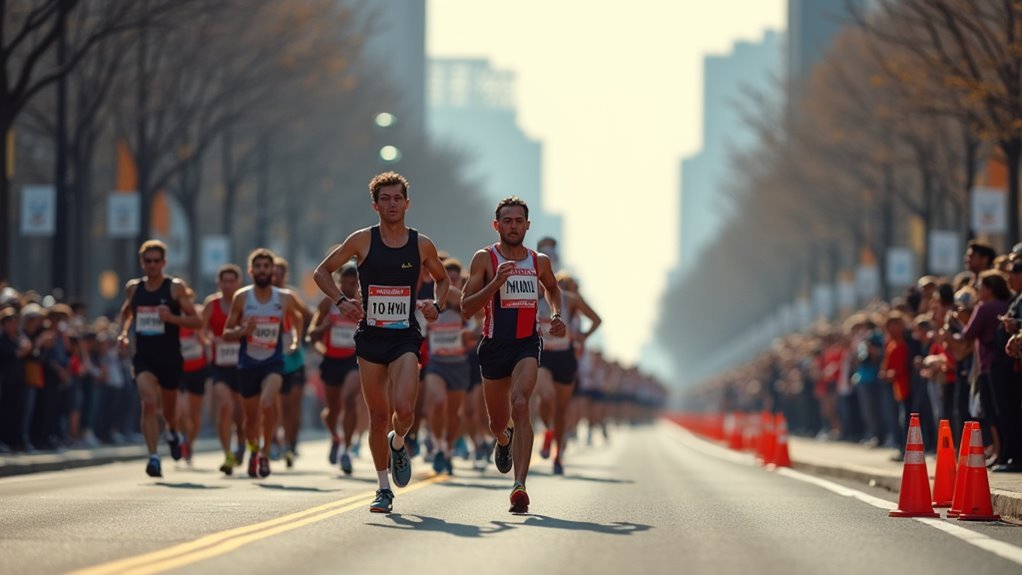

A marathon is exactly 26.2 miles, which equals 42.195 kilometers and became the standard distance at the 1908 London Olympics. That length represents a serious physical and mental challenge for runners of all levels. Terrain, temperature, and course layout all influence how fast someone can run those miles. Training, fueling, and pacing strategies change based on those conditions. This article explains what the distance means, how courses vary, and what affects race performance.
How Long Is a Marathon Race?
A marathon race is 26.2 miles, which equals 42.195 kilometers or 26 miles and 385 yards.
That fixed distance can feel huge initially, but you’re not alone in pondering about it.
Once you hear training myths, like needing to run every day or never walk, you can let them go.
Smart prep helps you build steady confidence, one run at a time.
Then your focus shifts from fear to rhythm, and that matters more than guesswork.
On race day, finish rituals can give you calm, whether you smile, grab water, or thank the people beside you.
You’re joining a group that knows this challenge, and that shared effort makes the miles feel more doable.
Why a Marathon Measures 26.2 Miles
You may consider 26.2 miles came from a neat round number, but it actually grew from a real course and a real need for a standard. The 1908 London Olympics set the key distance after the route ran from Windsor Castle to the stadium finish. Since then, world athletics has kept that historic length so every marathon race stays fair and easy to compare.
Olympic Distance Standard
Since the modern marathon grew out of the 1908 London Olympics, its distance was locked in at 26 miles and 385 yards, which equals 42,195 meters. That became the Olympic standard, so you can trust every official race to match it.
As you line up at the start, you join runners everywhere who face the same challenge, no matter the city. Course certification helps keep that promise, because race officials measure the route carefully before anyone pins on a bib. So your 26.2-mile run feels familiar and fair, whether you chase a personal best or simply finish proud. That fixed distance lets you compare efforts, share stories, and know you’re part of the same marathon community.
Historic Course Adjustment
Although the marathon now feels like a clean, fixed trial of 26.2 miles, that exact number came from a very specific course change in 1908. You can thank route politics and measurement controversies for the extra 385 yards.
In London, officials started at Windsor Castle so the royal family could watch, then moved the finish near the stadium box. That choice shaped the race for good.
- The start fit the city’s needs.
- The finish served the crowd.
- The extra yards settled argument.
- You still race that same distance today.
Marathon Distance in Kilometers
A marathon covers 42.195 kilometers, which runners usually round to 42.2 kilometers in everyday conversation. Whenever you see that number, you can envision the full challenge more clearly, and you don’t need to guess. This fixed distance helps you compare races on fair ground, whether you’re chasing an initial finish or a personal best.
Because the route stays the same, you can plan smarter with hydration strategies and study elevation profiles before race day. That prep can calm nerves and help you feel ready with the crowd around you.
In simple terms, 42.2 kilometers means about 105.5 laps on a 400-meter track, so the scale is real, but still manageable as you break it into steps and keep moving together.
Half Marathon vs. Marathon Distance
The half marathon and the marathon could sound close, but the gap between them is big enough to change your whole race day. A half is 13.1 miles, while a marathon doubles that to 26.2, so your training mileage and race logistics need a bigger plan. You’ll feel that shift in your legs, your focus, and your prep.
- A half asks for speed and control.
- A marathon asks for patience and steady effort.
- A half needs less fueling and gear.
- A marathon makes every detail matter more.
If you’re moving up, don’t worry. You’re still part of the same runner crowd, just taking on a longer road with more shared grit and more cheering at the finish.
How Long a Marathon Takes Most Runners
Most runners finish a marathon in about 3 to 6 hours, so your time can vary a lot from one race to the next.
Your pace, training, course hills, weather, and even how well you fuel all play a part in how long you stay out there.
Should you be newer to the distance, it’s normal to take longer, and a steady run-walk plan can still get you to the finish strong.
Average Marathon Times
Usually, marathon times land in a wide range, and that’s completely normal. You’re in good company whether you finish near four hours or much later. Most runners cross in about 3 to 6 hours, and the global average sits near 4:30. That means your result can still feel proud and real, even provided it’s not flashy.
- Under 3 hours: fast race day
- 3 to 4 hours: strong, steady finish
- 4 to 5 hours: common for many runners
- 5+ hours: still a marathon finish
Your pace distribution helps you see where you fit, and smart recovery strategies can keep you ready for the next start line. So, you don’t need to compare yourself too harshly. Your marathon time tells your own story.
Factors Affecting Pace
Even a small change in pace can shape how long your marathon takes, because your body has to balance speed, energy, and endurance for every mile.
You’ll notice that hills, turns, and terrain variation can slow you down, so you might need to adjust your rhythm instead of chasing a perfect split.
Weather matters too, since heat, wind, and humidity can drain you faster than you expect.
Your training also guides your pace, and whenever you trust your workouts, you usually feel steadier.
Group strategies can help as well, because running with others can calm your nerves and keep you settled initially.
Still, you should listen to your breathing, legs, and focus.
If you stay patient, you give yourself a better shot at finishing strong with your crew.
Finish Time Ranges
A marathon can feel long in a very real way, and the clock makes that clear fast. Most of you’ll finish in about 3 to 6 hours, and that range helps you feel less alone on race day.
- Elite runners often fly in under 2:30.
- Strong club runners might land near 3 to 4 hours.
- Many everyday runners cross between 4 and 5:30.
- Walk-run plans can stretch to 7 hours or more.
Your time depends on fitness, course, weather, pace variability, and how well you trust your recovery strategies. So should your finish look slower than someone else’s, that’s okay. You’re still in the same marathon family, and your effort still counts.
How Marathon Pacing Affects Your Finish
How you pace your marathon can shape your whole race, because the way you start, settle in, and finish all work together. In case you go out too fast, you might burn through your energy prematurely and lose time later. Whenever you hold back with control, you give yourself a better chance to keep moving strong with the pack.
A negative splits strategy can help you finish faster than you began, and that steady rhythm often feels calming. Should you need support, run walk intervals can still protect your pace and keep you in the race.
You don’t have to chase anyone else’s plan. Instead, trust yours, stay patient, and let each mile add up to a finish you can feel proud of.
What Happens at Mile 20 of a Marathon?
At mile 20, your legs often feel heavy, and that tired, gritty feeling can hit hard.
You may also meet the mental wall here, once your pace starts to slip and doubt creeps in.
That’s why fueling sooner and keeping a steady rhythm can help you push through this tough stretch.
Mile 20 Fatigue
By mile 20, your marathon starts to feel very real, and your body often reminds you of that fact in a loud way. You might feel heavy legs, a slower stride, and a sudden need to focus on each step. This is where carbohydrate timing starts to matter, because your fuel stores are dropping fast. It’s also where neuromuscular fatigue can make your form feel less smooth.
- Your pace could wobble.
- Your legs can burn.
- Your breathing might feel harder.
- Your rhythm can break.
Still, you’re not alone out there. Every runner in the field knows this stretch, and that shared struggle can feel oddly reassuring. Should you keep moving with patience, you stay in the race and give your body a chance to recover enough for the final miles.
Mental Wall Effects
Then comes mile 20, and the “wall” can hit your mind as hard as it hits your legs.
You might feel mental fatigue rush in, making every step seem longer and every cheer feel farther away.
That’s normal, and you’re not weak for noticing it.
Your brain starts asking for comfort, but you can answer with simple motivation strategies.
Break the race into small pieces, focus on the next turn, and repeat a short phrase that keeps you steady.
Look around and recall you’re part of a big, shared effort, not alone out there.
If doubt shows up, stay kind to yourself and keep moving forward.
In this stretch, calm confidence matters more than perfect energy.
Fueling And Pace
Fueling and pacing start to matter even more once you reach mile 20, because your stored energy is running low and your effort can get out of control fast. You’re not alone there; every marathon runner feels this trial. Keep your pace steady, then use glycogen timing and hydration strategies to stay in the game.
- Take fuel before you feel empty.
- Sip sooner, not just whenever you’re thirsty.
- Shorten your stride if your form slips.
- Trust the pace you trained for.
At mile 20, small choices protect you from a hard crash. Should your breathing stays calm, you can keep moving with the group around you and feel stronger in the last stretch. Stay patient, stay focused, and let your plan carry you forward.
Marathon Training Plan Basics
A good marathon training plan gives you a clear path from your initial easy run to race day, and it helps you build fitness without burning out. You’ll feel less lost whenever you map each week around easy miles, one long run, and rest days. That steady rhythm supports injury prevention and keeps you in the game with your crew. Cross training also matters, because biking, swimming, or strength work can build fitness while your joints catch a break.
| Plan piece | Why it helps |
|---|---|
| Easy runs | Build stamina |
| Long run | Teach endurance |
| Rest or cross training | Protect recovery |
Most runners need 16 to 20 weeks, so give yourself room to grow. Should you stay patient, your body will adapt, and race day won’t feel like a surprise.
What to Eat Before a Marathon
Getting your pre-race meal right can calm your nerves and help your body feel ready as the starting line gets close. You want simple foods that sit well and give steady energy, so you can feel like you belong with the runners around you.
- Choose pasta, rice, or oats for carb loading strategies.
- Add a little protein, like yogurt or eggs.
- Keep fiber and spicy foods low.
- Drink water beforehand, then sip enough to stay comfortable.
The night before, eat what you trust, not what looks exciting at 9 p.m. Pair that with sleep optimization, because rest helps your legs store fuel and your mind stay calm.
In the morning, keep it light and familiar, so you start steady, confident, and ready to run with the pack.
What to Expect at Aid Stations
At aid stations, you can expect a quick mix of water, sports drink, and sometimes simple fuel like gels or fruit.
You’ll need to move fast, grab what works for you, and keep your rhythm steady so you don’t lose time or confidence.
These stops can feel busy, but with a little planning, they’ll give you the support you need right as your body starts asking for it.
Aid Station Basics
Most aid stations are simple, busy, and surprisingly comforting once you know what’s there. You’ll see a row of volunteers, quick smiles, and clear signs that help you stay calm. Good water logistics and volunteer training keep the flow smooth, so you can move in, grab what you need, and keep going without feeling lost.
- Water gets handed out fast.
- Volunteers point you to the right side.
- You can slow down before you reach the table.
- You’ll leave feeling like part of the crowd.
That little rhythm matters. Whenever you know the station is there, you don’t feel alone out on the course. You feel supported, and that can steady your pace and your nerves.
Available Fuel Options
Once you know where the aid station is, the next question is what you can actually grab there, and that answer can make your race feel a lot easier. You’ll usually find water, sports drink, and sometimes bananas or orange slices. Some races also offer energy gels, electrolyte tablets, and salt packets for whenever you need a fast lift.
| Item | Use | Best Time |
|---|---|---|
| Water | Sip and stay steady | Any mile |
| Sports drink | Replace carbs and fluids | Hot stretches |
| Energy gels | Quick energy | Before a climb |
| Electrolyte tablets | Add minerals | In case you sweat a lot |
| Fruit | Gentle fuel | Later miles |
Pick what your stomach trusts, then keep moving with your crew mentality.
Quick On-Course Support
Aid stations can feel like little rescue stops whenever your legs start to protest, and that’s exactly what they’re there for. You’ll usually find cups of water, sports drink, and sometimes gels or simple snacks, so you can keep moving without panic.
Good hydration logistics mean you grab, sip, and leave cleanly, while volunteer coordination keeps the line smooth and friendly.
- Reach for the cup promptly, then slow your stride.
- Pinch the top so you don’t wear the drink.
- Take what you need, but don’t linger.
- Thank the volunteers, because they’re your race-day crew.
Once you pass through calmly, you protect your rhythm and help everyone around you feel steady too.
How Marathon Courses Vary
Even though every marathon covers the same 26.2 miles, the course itself can feel very different from one race to the next. You’ll notice course variability in the layout, the turns, and the surface under your feet. Some routes guide you through flat city streets, while others add hills that change your rhythm. Those elevation profiles can make a race feel kinder or tougher, even though the distance stays exact.
You could also run past wide boulevards, quiet neighborhoods, or winding park paths, and each setting shapes your focus. Because of that, you and other runners often compare races according to feel, not just by miles. Once you understand this, you can pick a course that matches your goals and helps you feel at home.
How Weather Changes Marathon Difficulty
After you consider about hills and turns, weather can feel like the concealed player in the race, and it can change how hard those 26.2 miles feel from start to finish.
Once the air turns hot, your body works harder, and your pace might slip.
Cold rain can also stiffen your muscles and shake your focus.
- Heat acclimation helps you train your body to handle warmth better.
- A smart hydration strategy keeps you steady before thirst hits.
- Wind can save or steal energy, so group effort matters.
- Humidity can trap sweat, so you might need to slow down and stay calm.
You’re not alone in this.
Every runner faces the same sky, and that shared challenge can make the course feel like a team effort.
What First-Time Marathoners Can Expect
For your initial marathon, the biggest surprise is often not the distance itself but how long and unpredictable the day can feel. You might start with pre race jitters, then settle in once the crowd moves and your breathing finds a rhythm.
At times, you’ll feel strong and steady, and at others, you’ll ponder why every mile seems to stretch. That’s normal. Many beginner runners learn that pacing matters more than bravado, and that walking a bit doesn’t mean you’ve failed.
You’re joining a patient, determined group, and that counts. After the finish, your legs could feel heavy, your smile might still show up, and post race recovery becomes part of the win. Give yourself grace, rest well, and let the day sink in.
Race-Day Checklist for Marathoners
Packing your race-day bag the night before can calm your nerves and save you from a rushed morning.
Your gear checklist should feel like a team huddle, not an exam. Pack what keeps you steady, then trust it.
- Bib, pins, and ID
- Shoes, socks, and favorite clothes
- Fuel, water bottle, and salt tabs
- Phone, watch, and post race logistics memo
Next, set out breakfast, check the weather, and pin your bib where you can grab it fast. You’ll feel more in control once every item has a spot.
Keep a small trash bag handy for wet clothes, too. On race morning, breathe, arrive promptly, and stick with your people. Then you can focus on the start, not the scramble.
Frequently Asked Questions
How Long Is a Marathon in Meters?
A marathon is 42,195 meters, and you can use that marathon conversion to plan your meters training. You will know exactly what you are preparing for, and you will feel part of the race community.
Who Standardized the Marathon Distance?
It was Olympic decision makers, guided through royal influence, who standardized it; you’ll fit right into marathon history once you know this. They fixed the course after 1908, and the distance later became officially adopted worldwide.
What Was the Original Marathon Distance?
You’ll find the original marathon distance was about 25 miles, or 40 kilometers, in the ancient legend from Marathon to Athens, before later standardization gave you today’s fixed 26.2 mile race.
Is a Marathon Always 26.2 Miles Exactly?
No, you won’t always see 26.2 miles exactly; most official races measure 26 miles 385 yards, or 42.195 km. You’ll stay with the pack via using smart pacing strategies and respecting race etiquette.
How Many Laps Is a Marathon on a Track?
You’d run about 105.5 track laps for a marathon on a standard 400 meter track, so pacing strategies matter. You’re not alone; many runners break it into manageable segments and share the same finish line goal.
