


A triathlon distance depends on the race type and ranges from short to very long. Sprint races are about 750 meters swim, 20 kilometers bike, and 5 kilometers run. Olympic distance is 1.5 kilometers swim, 40 kilometers bike, and 10 kilometers run. Half Ironman (70.3) combines a 1.9 km swim, 90 km bike, and 21.1 km run. Full Ironman is 3.8 km swim, 180 km bike, and 42.2 km run.
How Long Is a Triathlon?
A triathlon can be surprisingly short or very demanding, depending on the race format you choose. You may finish a beginner-friendly sprint in about 25.75 km, while an Olympic race covers 51.5 km and gives you a stronger challenge without feeling endless.
Should you keep going, middle and long events like 70.3 or T100 ask for much more time and focus. Then there’s the full Ironman, and that one can take 9 to 17+ hours for age-group athletes.
So you’re not picking just a distance; you’re choosing your day’s rhythm. Good training nutrition helps you stay steady, and a smart weather strategy can save energy should heat or wind show up.
Whatever you pick, you’re part of the triathlon crowd.
Triathlon Distances by Race Type
Triathlon race distances can feel confusing at initially, but they make more sense once you see the pattern.
| Race type | Swim/Bike/Run | Total |
|---|---|---|
| Sprint | 750 m, 20 km, 5 km | 25.75 km |
| Olympic | 1.5 km, 40 km, 10 km | 51.5 km |
| Long course | 2 km, 80 km, 20 km | 102 km |
| Half Ironman | 1.9 km, 90 km, 21.1 km | 113 km |
You can pick a distance that fits your age categories, goals, and schedule, and you’re not alone provided the numbers once looked huge. Relay formats also let you share the work with teammates, which can make race day feel more welcoming. Should you desire the biggest trial, the full Ironman asks you to swim 3.8 km, bike 180 km, and run 42.2 km.
What Happens in T1 and T2?
Once you know how far each race goes, the next big question is what happens as you move from one sport to the next.
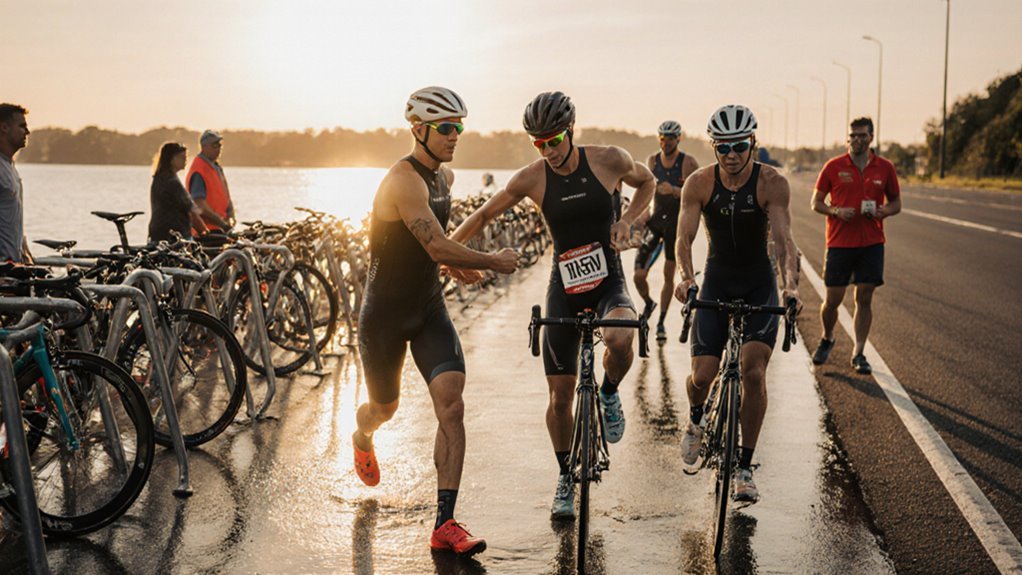
In T1, you leave the water, strip off a wetsuit provided that you wore one, grab your bike, and get your helmet and shoes on before you cross the mount line.
In T2, you hit the dismount line, rack your bike, remove your helmet, and change into running shoes.
Good changeover mechanics matter because every second counts, and a tidy setup can save minutes.
Your time in changeover counts in the race total, so smart gear placement helps.
Stay inside the marked areas, because officials watch for rule breaks and can issue official penalties.
Different events use different changeover layouts, but the steps stay the same.
How Long Do Sprint and Olympic Races Take?
Sprint and Olympic triathlons can feel very different on race day, and the finish time tells that story fast.
In case you race a sprint, you’ll usually spend about 1 to 1.5 hours out there, while strong age-groupers and pros might finish in 45 to 60 minutes.
In an Olympic race, you’re more likely to need 2 to 3 hours, though top men often land near 1:45 to 2:00.
Your race pacing matters a lot, because sprint effort stays hard and sharp, while Olympic effort asks for steady aerobic strength.
Changeover time also counts, so don’t forget those minutes.
A smart nutrition strategy helps too, especially provided the course, weather, or drafting rules stretch your day a bit.
How Long Are 70.3 and Ironman Races?
A 70.3 race covers 70.3 miles total, with a 1.9 km swim, a 90 km bike, and a 21.1 km run, so it’s exactly half of a full Ironman in each leg.
A full Ironman stretches to 140.6 miles, with a 3.8 km swim, a 180 km bike, and a 42.2 km marathon run.
You’ll also notice the finish times change a lot, since many 70.3 athletes finish in about 4 to 8 hours, while a full Ironman often takes 9 to 17 plus hours.
70.3 Race Distance
Stretching beyond the shorter race formats, the 70.3 distance gives you a true middle ground between speed and endurance.
You swim 1.2 miles, bike 56 miles, and run 13.1 miles, for a total of 70.3 miles.
Each leg is exactly half of a full Ironman, so you get the same race shape without the same huge time load. That balance helps you build confidence while still challenging your body and mind.
Your course terrain can change the challenge a lot, so hills, wind, and heat matter.
Good changeover efficiency also helps you save energy and stay calm.
Most athletes finish in about 4 to 8 hours, so smart pacing and fueling keep you moving with the group.
Ironman Race Distance
Now that you know the 70.3 distance, it helps to see how it compares with the full Ironman race. You’re looking at a true step up: a 70.3 is 1.2 miles swim, 56 miles bike, and 13.1 miles run, while an Ironman doubles each leg to 2.4, 112, and 26.2.
| Race | Total | Legs |
|---|---|---|
| 70.3 | 70.3 mi | Swim, bike, run |
| Ironman | 140.6 mi | Swim, bike, run |
| Course variations | change layout | same challenge |
That bigger distance means you’ll feel every mile, even with course variations. You also need to follow equipment regulations, since both races keep gear rules tight. Should you be joining this community, you’re signing up for a big day, but you’re not doing it alone.
Typical Finish Times
Should you’re questioning how long a 70.3 or full Ironman race really takes, the short answer is that it depends a lot on your fitness, the course, and the weather.
For a 70.3, you’ll often see age-group finishers land between 5 and 8 hours, while strong age-groupers could go 4.5 to 5.5 hours. Pros usually finish around 4 to 5 hours.
A full Ironman is a bigger day, with amateur times commonly ranging from 9 to 17+ hours, and pros often finishing in 8 to 10 hours.
Hilly routes, heat, and fueling choices can stretch your day, so smart race pacing matters. Also, solid transition practice can save minutes and help you feel part of the pack, not behind it.
Which Triathlon Distance Is Right for You?
Should you’re new to triathlon, a Sprint race can feel like the right starting line because it matches your current fitness without asking for too much time.
Should you want a bigger challenge, consider how many hours you can train and recover, since Olympic, 70.3, and Ironman races each ask for more endurance and planning.
The best choice is the one that fits your experience, your schedule, and the goal you want to chase.
Match Distance To Experience
Finding your best triathlon distance starts with being honest about where you’re right now, because the right race should challenge you without crushing your spirit. Suppose you’re building a beginner progression, start with a Sprint and trust your training consistency. It gives you room to learn without feeling buried.
- New to multisport? A Sprint fits well.
- Got a solid base? Try an Olympic race for a stronger trial.
- Ready for long days? Pick a 70.3, T100, or Ironman only assuming your experience matches the load.
Shorter races reward speed and smooth shifts, while longer ones ask for patience, pacing, and smart fueling. So choose the distance that feels like your crew is cheering for your growth, not demanding perfection.
Time Commitment Matters
Time, more than almost anything else, can make or break your triathlon choice, because a race that fits your schedule feels exciting instead of overwhelming.
| Distance | Race Time | Weekly Training |
|---|---|---|
| Sprint | 1 to 1.5 hrs | 4 to 6 hrs |
| Olympic | 2 to 3 hrs | 6 to 10 hrs |
| 70.3 | 5 to 8 hrs | 8 to 12+ hrs |
| Full | 9 to 17+ hrs | 10 to 20+ hrs |
If you want strong training balance, start with the hours you can really give. A sprint usually asks for less recovery planning, so it can fit busy weeks and still leave you smiling. Olympic racing needs more of your day, yet it still feels manageable for many people. A 70.3 or full Ironman asks for bigger blocks, more support, and more rest after. Pick the option that lets you join the crowd with confidence.
Choose Your Race Goal
Now that you can see how much time each race can take, the next step is to match that with your real goal. Pick the distance that fits your life, your body, and the kind of finish line you want to share with others.
- Should you want a beginner-friendly day and a quick win, choose a Sprint.
- Were you seeking a bigger trial with solid bragging rights, go for Olympic or 70.3.
- In case you want a true all-day challenge, aim for T100 or Ironman.
Your training plans should match the distance, because a Sprint asks less of you than an Ironman, and your recovery strategies should do the same. Once you choose well, you’ll feel like you belong in the race, not like you’re chasing it.
Frequently Asked Questions
What Is a Typical Triathlon Length?
A typical triathlon is a sprint: 750 m swim, 20 km bike, and 5 km run. You’ll adjust training intensity and equipment choices so you fit in, feel ready, and enjoy race day with others.
What Is a 100KM Triathlon?
A 100 km triathlon is a fast, long course race with a 2 km swim, 80 km bike, and 18 km run. You’ll feel the team relay energy, and it’s longer than an ultra sprint, yet still spectator friendly.
