

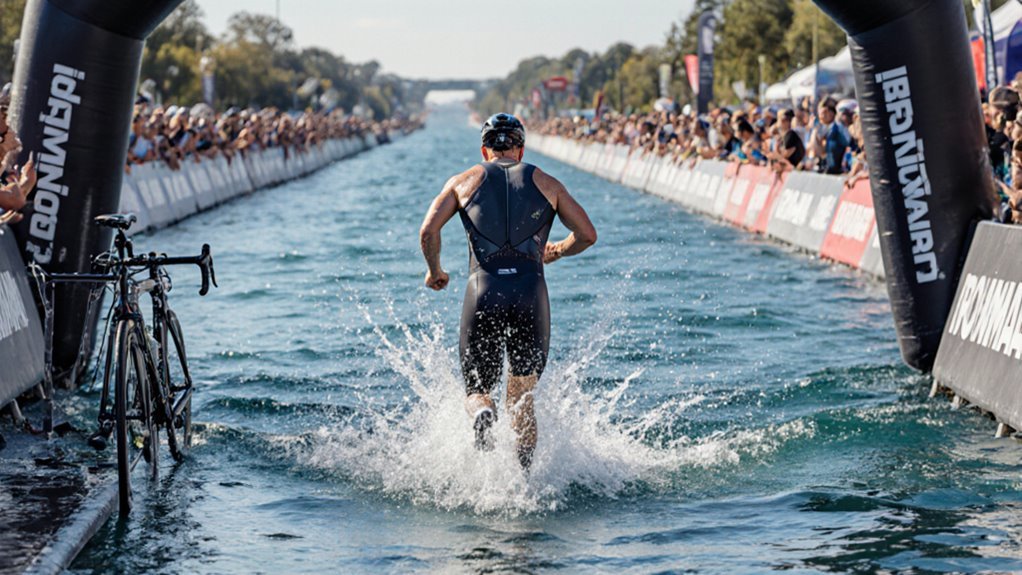

An Ironman triathlon covers 140.6 miles: a 2.4-mile swim, a 112-mile bike ride, and a 26.2-mile marathon run. The event stacks three endurance disciplines with continuous timing, including transitions between segments. Athletes face varied terrain, technical course challenges, and significant fueling and pacing demands. Race-day conditions and course profiles heavily influence finishing times and strategy. Training for an Ironman requires focused aerobic development, practice with nutrition and gear, and experience managing long-duration effort.
What Is an Ironman Triathlon?
An Ironman triathlon is one of the toughest endurance races you can take on, and that’s exactly why it draws so much respect. You join a race that starts with a 2.4-mile swim, then moves to a 112-mile bike ride, and finishes with a 26.2-mile run. You race those parts in order, with timed handoffs that keep the pressure real.
Its race origins trace back to 1978 on Oʻahu, Hawaiʻi, and that story still gives the event its grit. You’ll also make smart equipment choices, because your gear can help you stay steady, safe, and ready for each stage. The Ironman name belongs to the World Triathlon Corporation, and its famous tagline says it all: swim, bike, run, then earn your bragging rights.
How Long Is an Ironman Triathlon?
A full IRONMAN triathlon is a huge day, but the total distance is clear: you’ll cover 140.6 miles, or 226.3 kilometers, across three parts. You start with the swim, then move to the bike, and finish with the run. Shifts count too, so every minute matters.
| Part | Distance | Notes |
|---|---|---|
| Swim | 2.4 miles | Ocean currents and wetsuit technology can shape this leg |
| Bike | 112 miles | Longest segment |
| Run | 26.2 miles | Full marathon finish |
Most races cap your day at about 16 to 17 hours. Pros could finish in 7:30 to 9:30, while you’ll likely spend far longer. Were you targeting 70.3, that’s half the distance, but full IRONMAN is the big shared challenge.
How Long Is the Swim in an Ironman?
In an Ironman, you start with a 2.4-mile swim, which is about 3.8 to 3.9 km, so you know right away this race asks a lot from you. You’ll usually need to finish that swim in about 2 hours and 20 minutes to keep going.
Because it happens in open water and leads straight into the bike, the swim sets the pace for everything that comes next.
Ironman Swim Distance
The Ironman swim covers 2.4 miles, or 3.86 kilometers, of open water, and it sets the tone for the rest of the race. You’ll share the course with athletes who get your nerves and your drive, so breathe, stay calm, and trust your plan.
- You start initially, so the distance matters right away.
- Your wetsuit policy depends on water temperature, and that changes how you feel in the water.
- Strong water safety support, like kayaks and lifeguards, helps you keep moving with confidence.
Some races use rolling starts, while others use mass starts, and each one can feel different.
Because conditions shift by venue, you should expect chop, current, or cool water. Still, this leg is your chance to settle in, find rhythm, and join the race crew around you.
Swim Time Limits
That 2.4-mile swim sounds simple on paper, but the clock starts the moment your race begins, and that changes everything.
You usually face a swim cutoff of 2 hours 20 minutes, so pacing matters from the initial stroke.
Many races use wave starts or staggered entries, which helps you find space and stay safe while you swim with the crowd.
Your finish time can vary a lot: strong age-group athletes often land between 1:15 and 2:00, while pros might exit in about 45 to 55 minutes.
Water temperature also affects your plan, because wetsuit rules can require a suit in colder water or ban it in warm conditions.
Should you miss the cutoff, you won’t head to the bike.
How Long Is the Bike in an Ironman?
A full Ironman bike leg covers 112 miles, or 180.2 kilometers, so you’re looking at a long ride that sits right between the 2.4-mile swim and the 26.2-mile run. You’ll need steady pacing and smart bike nutrition, plus good gear aerodynamics, to stay strong with the race family around you.
- Flat courses can feel quicker and smoother.
- Hilly or technical routes usually cost more time and energy.
- Drafting isn’t allowed, so keep a 12-meter gap and pass within 25 seconds.
Most races also use a bike cutoff inside the full race time, often around 10:00 to 10:30 hours from the swim start. So, you’ll want to ride with focus, stay calm, and keep moving with confidence.
How Long Is the Run in an Ironman?
After that long bike leg, your legs still have one more big job, and it’s a marathon. In an Ironman, you run 26.2 miles, or 42.2 km, after the swim and bike. That makes it the final stretch of the 140.6-mile race, and you’re not alone in feeling that it sounds huge.
Your pace strategy matters here, because smart initial miles can help you stay steady later. Your fueling needs also matter, since your body needs regular energy to keep moving. Fast pros can finish in about 2:40 to 3:10, while many age-group athletes take 3:30 to 6+ hours.
Heat, hills, and fatigue can change everything, so stay patient, trust your plan, and keep taking one step at a time.
How Long Does an Ironman Take?
An Ironman usually takes most people the better part of a day, and that’s exactly why it feels so epic. You’re not just racing; you’re joining a tough, loyal crowd that knows patience matters.
Most athletes finish in 10 to 16 hours, while pros can fly through it in about 7:30 to 9:30. The clock also watches you closely, with overall limits near 16 to 17 hours.
- Your swim, bike, and run add up to 140.6 miles.
- Smart pacing strategies help you save energy at the outset.
- nutrition planning keeps you moving whenever your legs beg for mercy.
Course terrain, weather, and your fitness can change everything. On a flat, fast day, you might surprise yourself and still feel like you earned every cheer at the finish.
How Long Is an Ironman 70.3?
An IRONMAN 70.3 totals 70.3 miles, and you’ll cover that with a 1.2-mile swim, a 56-mile bike ride, and a 13.1-mile run.
That distance can feel huge, but it’s built for strong amateurs who want a serious challenge without the full Ironman load.
Most races also set a time limit of about 8 hours 30 minutes, so pacing matters just as much as power.
70.3 Race Distances
Visualize the finish line, because an IRONMAN 70.3 is exactly 70.3 miles of work split across three sports: a 1.2-mile open-water swim, a 56-mile bike ride, and a 13.1-mile run.
You’re not alone in these race distances; athletes everywhere chase the same challenge and the same esteem.
- Swim: you enter open water, often with wave starts.
- Bike: you ride 56 miles, and course variations can change the feel.
- Run: you finish with a half marathon.
Each part asks for grit, but it also gives you a place in the 70.3 community.
The structure stays the same worldwide, yet local routes keep it fresh.
70.3 Time Limits
Because the race sounds huge, it helps to know the clock before you even toe the line. You get up to 8 hours 30 minutes total in most IRONMAN 70.3 races, and that starts once the swim begins.
The course covers 1.2 miles in the water, 56 miles on the bike, and 13.1 miles on the run, so your cutoff strategies need to match each leg. Many events also set swim and bike cutoffs, often around 1 hour 10 minutes to 1 hour 30 minutes for the swim and 5 hours 30 minutes to 6 hours for the bike, but rules can shift. Should you be planning spectator logistics, these checkpoints matter too. Fast pros finish in about 4 hours, but your race is about smart pacing, steady effort, and staying with your people. Check the athlete guide initially.
What Affects Ironman Finish Times?
Your Ironman finish time doesn’t come from the 140.6-mile distance alone, since the course itself can change everything from your rhythm to your energy.
You’re part of a huge crew chasing the same finish line, and a few race-day factors matter most:
- Flat courses usually let you move faster.
- Heat, humidity, wind, and rough water can slow you down, so heat acclimation helps.
- Your pacing psychology, nutrition, and hydration can keep you steady instead of fading late.
If you race in Kona heat or strong crosswinds, you’ll likely feel the difference fast.
Pro men often finish in 8 to 9 hours, while age-group athletes can range much wider.
Race cutoffs also shape how hard you push, so you need a plan that fits the course and keeps you in the race.
How Long Does Ironman Training Take?
Training for an Ironman is a long build, but it doesn’t have to feel endless as you break it into stages. Should you’re starting from a sedentary base, plan on about 12 months. In case you’re already fit, you might be ready in 6 to 9 months with smart coaching.
Most of your season follows base, build, race-specific, taper, and recovery phases, so each block has a clear job. You’ll usually train 10 to 20 hours a week as an age-grouper, with long rides, long runs, swims, strength, and rest.
That steady progressive overload helps you grow without breaking down. Along the way, you also build mental resilience through practicing fueling, pacing, and patience. You’re not alone in this process; you’re joining a prepared, disciplined crowd.
Where Is the Ironman World Championship Held?
After you’ve visualized the long build to race day, it helps to know where the biggest stage sits. For years, you’d point to Kailua-Kona, Hawaiʻi, and feel the pull of Kona history. The race began in Oʻahu in 1978, then settled on the Big Island in 1981, where heat, wind, and lava rock made it legendary.
- Kailua-Kona: the classic full-distance home
- Nice, France: the women’s 2024 venue
- Venue rotation: a newer pattern that lets the championship move
You still start and finish on Aliʻi Drive whenever Kona hosts, with the swim in Kailua-Kona Bay, the bike toward Hāwī, and the run along the coast. That mix helps you feel part of a tough, welcoming tribe. The 70.3 World Championship rotates more often, so the stage can change year to year.
Who Are the Current Ironman World Champions?
You’re looking at the reigning 2024 IRONMAN World Champions: Patrick Lange won the men’s race in Kona in 7:35:53, and Laura Philipp took the women’s title in Nice in 8:45:15.
Should you’re tracking the faster side of the sport, Jelle Geens and Taylor Knibb also claimed the 2024 IRONMAN 70.3 World Championship crowns in Taupō. Knibb’s third straight 70.3 world title and Lange’s record Kona time show you just how sharp the top pros are right now.
Reigning World Champions
The current Ironman world champions are Patrick Lange and Laura Philipp, and both earned their titles in 2024 with standout races that showed real grit and control. In case you follow the sport, you’re part of a global group that values patience, focus, and heart. Their wins also show why course strategy and athlete recovery matter so much.
- Patrick Lange leads the men’s title chase.
- Laura Philipp holds the women’s crown.
- You can earn the same dream through yearly qualifying races.
These championships rotate between places like Kailua-Kona and Nice, so each course asks something different from you. That’s why the title feels so special. You’re not just racing the clock. You’re joining a field built on discipline, smart pacing, and steady recovery after hard training blocks.
2024 Championship Results
With the 2024 championship races now in the books, Patrick Lange and Laura Philipp stand as the current Ironman world champions. You can feel the pace they set in Kona and Nice, where course conditions pushed every athlete hard. Lange won the men’s race in Kailua-Kona in 7:35:53, and Philipp claimed the women’s title in Nice in 8:45:15. Their results show how fast the front of the sport has become, and you’re part of a global community that follows every split.
| Champion | Venue | Time |
|---|---|---|
| Patrick Lange | Kona | 7:35:53 |
| Laura Philipp | Nice | 8:45:15 |
| Jelle Geens | Taupō | 3:32:09 |
In Taupō, Jelle Geens and Taylor Knibb added more excitement, with Knibb earning her third straight 70.3 crown and the prize money spotlight.
What Are the Fastest Ironman Finish Times?
Remarkably, the fastest Ironman finish times push human endurance to a level that still feels almost unreal, and they give you a clear sense of just how fast elite triathletes can move across 140.6 miles. In record keeping subtleties, you’ll see why course specific comparisons matter, because every race tells its own story.
- Kristian Blummenfelt holds the fastest IRONMAN-branded time at 7:12:12 in Cozumel in 2021.
- Laura Philipp owns the fastest women’s IRONMAN-branded time at 8:18:20 in Hamburg in 2022.
- On Kona’s tough World Championship course, Patrick Lange’s 7:35:53 and Daniela Ryf’s 8:26:18 show how heat and wind slow even the best.
That’s why you can’t judge every fast finish the same way. The numbers still feel astounding, and they help you belong in the bigger Ironman story.
What Is the Ironman Pro Series?
A new layer of drama now sits inside Ironman racing, and it’s called the IRONMAN Pro Series. You join a season-long fight where pros race for points, not just medals. In 2026, 17 races on the Global calendar count, and only professionals can enter. That pro only entry keeps the field tight and serious.
| Feature | What it means | Why it matters |
|---|---|---|
| Pro Series | Year-long contest | Rewards steady racing |
| points structure | Top five results count | One bad day won’t ruin you |
| Global calendar | 17 scored races | You can follow pros worldwide |
Frequently Asked Questions
What Gear Is Required for an Ironman Triathlon?
You need a tri suit, swim goggles, wetsuit choice, bike fit, helmet, shoes, nutrition, and race belt—what else carries you through those miles? You’ve got this, and you’ll belong on course.
How Many Aid Stations Are on an Ironman Course?
You’ll usually find aid stations every 10 to 15 miles on an Ironman course, though the number varies. You can count on aid station supplies and volunteer logistics that keep you supported throughout the race.
Can You Draft Behind Other Cyclists in Ironman Races?
No, you cannot draft behind other cyclists in Ironman races; drafting rules ban it. You must keep legal spacing, respect pack rhythms, and ride your own race while still feeling connected to the field.
What Happens if You Miss an Ironman Cutoff Time?
In case you miss a cutoff, you are usually pulled from the race and you will feel the sting; only about 1% of finishers miss one. You will receive medical support if needed, and you can file a race protest.
How Do Athletes Qualify for the Ironman World Championship?
You qualify by racing designated Ironman events and earning qualifying slots through top age group finishes or championship rankings. You join a community of dedicated athletes chasing the same dream, and every placement counts.
