

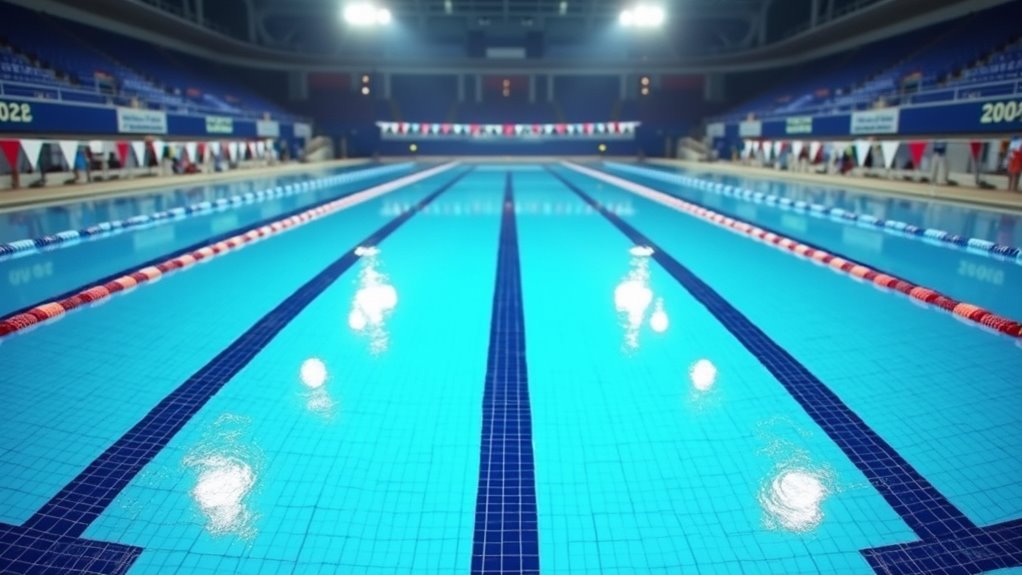

An Olympic swimming pool is exactly 50 meters long, measured from touchpad to touchpad. That standardized length sets the stage for Olympic events and world records. Race strategies, turn counts, and split times all depend on that 50-meter distance. Short-course pools (25 meters) and typical public pools differ, affecting pacing and training results. Knowing the official length clarifies why competitive swimming uses specific pool sizes and timing rules.
How Long Is an Olympic Swimming Pool?
An Olympic swimming pool is 50 meters long, which is about 164 feet, and that’s the standard you’ll hear most often in swimming. When you step onto the deck, you’re sharing the same long-course space that shapes Olympic rituals and steady focus.
You can envision the lanes stretching ahead, and that shape supports smooth swimmer ergonomics, so your stroke feels natural and your turns stay clean. Because the length is measured end to end between the touch pads, you know the race follows one clear rule.
That consistency helps you feel part of the same system as every other swimmer. So whether you’re training, cheering, or just learning, you can trust this simple answer: an Olympic pool is 50 meters from wall to wall, and that’s the standard.
Why Olympic Pools Are 50 Meters Long
You’ll see that 50 meters sets a clear race distance, so every swimmer faces the same challenge from start to finish.
That standard helps officials compare times fairly, and it keeps records meaningful across meets around the world.
It also guides international pool design, since organizers build competition pools to match the same long-course setup wherever swimmers race.
Standard Race Distance
The race distance sets the rule, and that’s why Olympic pools stay 50 meters long. Whenever you race, you need the same setup every time, so you can trust your pace and compare your stroke efficiency with others. That steady length helps you settle in, breathe on rhythm, and feel like you belong in the lane.
| Race distance | Pool length | Effect |
|---|---|---|
| Sprint events | 50 m | Fast starts |
| Middle races | 50 m | Even pacing |
| Long-course meets | 50 m | Fair records |
| Touch pads | End to end | Exact measure |
| Shared standard | 50 m | Clear competition |
Because the distance never shifts, you can focus on swimming well, not guessing the course.
International Pool Design
International standards shape every Olympic pool, and that’s why the 50-meter length matters so much. You get the same racing space wherever athletes meet, so everyone feels part of one fair field.
Designers follow local regulations, but they still protect the global standard through modular construction and careful planning. That helps with climate resilience, because pools can handle heat, cold, and heavy use.
At the same time, sustainable filtration keeps water clean without wasting energy. Cultural adaptation also matters, since each host city brings its own style and needs.
Even so, heritage preservation can guide the look and feel of the venue. This balance lets you trust the pool, race hard, and belong in a shared Olympic tradition.
How Pool Length Affects Racing
Race times often hinge on tiny details, and pool length is one of the biggest ones. Whenever you race in a 50-meter pool, each length changes your stroke strategy and your rhythm.
You feel fewer turns than in a shorter pool, so you must hold speed longer and trust your pacing analytics. That can calm nerves, because you know every meter matters and your effort stays honest.
Also, the longer stretch lets you settle into a smooth tempo, which helps you stay with the group instead of chasing too hard beforehand. Should you swim with teammates, you’ll notice how this shared rhythm builds confidence.
In the end, pool length shapes how you breathe, move, and stay focused as the race gets tough.
How Wide and Deep Is an Olympic Pool?
An Olympic pool is usually 25 meters wide, and that width gives you enough room for 10 lanes of racing.
You’ll also find that the water stays at least 2 meters deep, with many pools built even deeper to help swimmers move more smoothly.
Pool Width Standards
Most Olympic swimming pools are built 25 meters wide and divided into 10 lanes, with each lane usually measuring 2.5 meters across. Whenever one looks at the lane markings, you can see how they guide swimmers and help one follow the race with ease.
That clear layout also gives one a fair sense of space, so you don’t feel crowded by the action. Provided you’re watching from the stands, spectator seating usually runs along the sides, letting you stay close to the water and feel part of the crowd.
This width supports smooth starts, steady turns, and clean racing lines. Together, the lanes and seating create the familiar Olympic atmosphere you expect, whereby every detail helps you feel included in the competition.
Pool Depth Requirements
Upon inspecting an Olympic swimming pool, the depth matters just as much as the length and width, because it helps the water stay calmer and the races feel fairer. You’ll usually see at least 2 meters, though 3 meters often feels better for serious racing. That extra depth supports swimmer safety, cuts splashback, and helps the pool keep steadier pool acoustics as the crowd gets loud. It also gives intake systems room to work without stirring the lane water.
- Deeper water can calm waves.
- Clear depth rules support fair starts.
- Lighting standards stay easier to manage over a stable surface.
What’s the Difference Between Short Course and Olympic Pools?
The gap is bigger than it looks at initial glance. In short course pools, you swim 25 meters, so you hit the wall more often. That changes Short course dynamics and makes Turn techniques matter a lot.
You can push off, glide, and break out more times, which can help whether you love rhythm and quick bursts. In an Olympic pool, you swim 50 meters between walls, so you spend more time holding pace and less time turning. That can feel calmer, but it also asks for steadier focus.
Should you’re training with a team or chasing a best time, appreciating this difference helps you fit in faster. You’ll feel the race flow differently, and that’s normal.
How Olympic Pools Compare to Standard Lap Pools
A lap pool and an Olympic pool could look close at initial, but their size can change how your whole swim feels. You notice it fast whenever you move from cozy backyard pools to a full 50-meter lane. In community pools, you might turn more often, which can keep things relaxed and familiar. An Olympic pool gives you longer stretches, so your rhythm settles in and you feel part of something bigger.
- A lap pool often fits smaller spaces.
- An Olympic pool usually has more lanes and room.
- The longer distance can feel smoother and steadier.
Why Pool Length Matters for Records
Whenever you care about records, pool length stops being a small detail and starts acting like the rulebook itself. You want every swim to feel fair, and that only happens whenever the course is exact. A 50-meter pool lets officials keep timing calibration steady, so one athlete’s race matches another’s.
Even tiny differences can change splits, and that can sting whenever you’re chasing a best time with your team behind you. Then altitude effects can add another layer, because thinner air can shift how you race and recover. So the measured distance matters just as much as strong strokes and fast turns.
Whenever you trust the pool, you can trust the record, and that helps everyone feel part of the same race.
Common Olympic Pool Myths
Even though Olympic pools seem simple, plenty of myths still float around them. You could hear weird measurement myths, and that can make you doubt what’s true. Most myth origins come from old news stories, casual pool talk, or people mixing up Olympic and short-course pools. Keep this in mind:
- A pool isn’t 25 meters long; that’s a different setup.
- The length is measured end to end between touch pads.
- Tiny pad allowances don’t change the official 50-meter standard.
When you hear someone call any large pool “Olympic,” check the facts before you join the chatter. You belong in the group that knows the real answer, and that answer stays simple: 50 meters.
Frequently Asked Questions
How Many Lanes Does an Olympic Pool Have?
An Olympic pool typically has 8 lanes, though some competition standards use 10 for lane configuration. You’ll usually race in 2.5 meter wide lanes, giving you fair, shared space and a true elite competition feel.
How Many Gallons Does an Olympic Pool Hold?
About 660,000 gallons, you’d fill a neighborhood’s ego. I once watched one being topped off; the water displacement felt like a giant heartbeat, and filtration efficiency kept every swimmer feeling they belonged.
What Is the Minimum Depth for an Olympic Pool?
You’ll need a minimum depth of 2 meters for an Olympic pool to meet safety standards. Deeper water often helps you race with less turbulence, and many venues aim for 3 meters for better conditions.
Are Olympic Pools Always Exactly 50 Meters Long?
No, Olympic pools are generally 50 meters long, though small measurement allowances exist for touch pads. Lane markings and starting blocks are set for official races so swimmers compete on the standard course.
Why Are Touch Pads Included in Pool Measurements?
They’re included because you need accurate timing technology and sensor calibration at the wall. You touch them to stop the clock, so measurements account for their thickness and keep your races fair, consistent, and official.
