

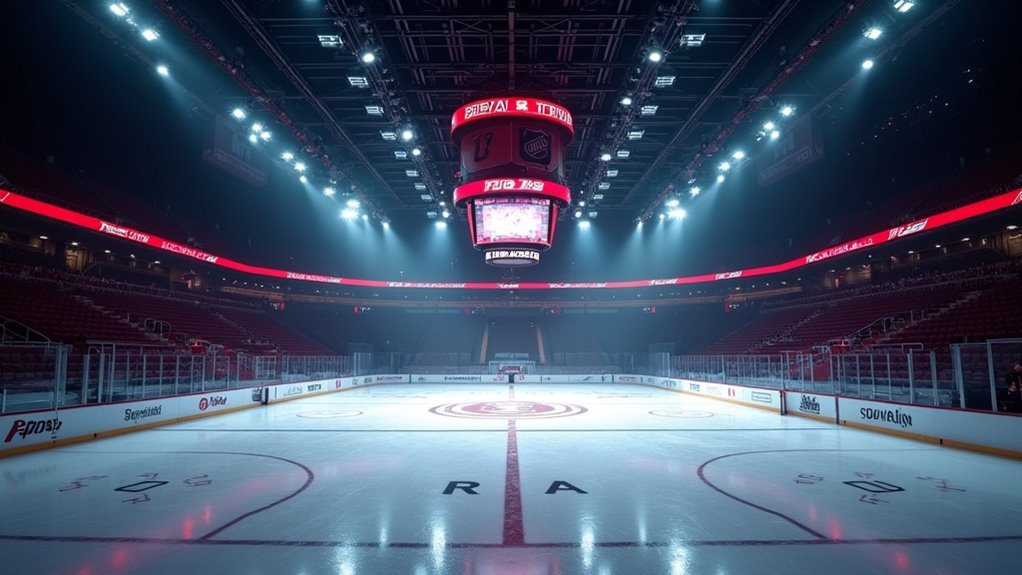

The NHL playoffs are a 16-team, best-of-seven elimination tournament that crowns the Stanley Cup champion. Teams qualify through division standings and two wild-card slots per conference. Matchups follow a fixed bracket with division rivalries set for early rounds. Overtime periods are sudden-death and continue until a winning goal is scored. Series intensity rises each round as teams need four wins to advance.
How the NHL Playoff Format Works
Once the regular season ends, the NHL shifts into a 16-team sprint for the Stanley Cup, and the setup is easier to follow than it initially looks.
You’re looking at two conference paths, each with eight teams, and a fixed bracket that keeps your side of the road clear. The top three teams in each division lock in, then wild cards fill the rest through points. That structure shapes playoff psychology because every game feels personal, and travel logistics stay tighter than a league-wide shuffle.
In the opening round, division rivals often meet sooner, so you get familiar matchups and quick adjustments. After that, winners stay in their bracket, which helps you track where your team stands without guessing. Each series is best-of-seven, so you know exactly what it takes to move on.
Which NHL Teams Make the Playoffs?
A full NHL playoff field starts with 16 teams, and those spots don’t go to the best clubs in one giant list. You’re in the frame when your team meets playoff eligibility after the regular season ends. Each conference sends eight teams, so your club has to stack up well inside its own side.
Most spots come from strong division play, while the last spots come from the next-best records in the conference. That means every point can matter, and tiebreak scenarios can decide who feels the rush and who heads home prematurely.
Provided your team stays close all year, you’re not just watching the race, you’re part of it. That’s why fans keep checking the standings, hoping their group still has a real shot.
NHL Division Winners and Wild Cards
You’ll see that the top three teams in each division lock in a playoff spot initially, so division winners matter right away.
Then the next two best teams in each conference grab the wild-card spots, even though they didn’t finish near the top of their division.
That mix keeps the race tight, and it gives you a few extra teams a real shot at the Cup.
Division Winners
Division winners give the NHL playoffs their initial shape, and that matters more than it originally looks. You get the top spot in your division, and that usually means a stronger path and a real lift for your group. Whenever teams finish close, division tiebreakers decide who stands foremost, so every point can feel huge. You’ll also hear captain recognition after the standings settle, because leaders often set the tone that got the team there.
| What you gain | Why it matters |
|---|---|
| Division title | Better placement |
| Higher seed | Stronger matchup |
| Tie edge | Clearer path |
| Team esteem | Shared belief |
That structure helps you feel part of something bigger, with your club earning respect before the opening puck drops.
Wild Card Spots
- You fight for one of four openings.
- You keep pace with teams across your conference.
- You learn the bracket can shift fast.
- You get a path into a tough opening round.
How NHL Seeding Works
As the NHL sorts out its playoff seeds, it’s really just trying to reward the teams that earned the best regular-season results while keeping the bracket balanced. You can imagine of seeding as your team’s position in the conference order, and that spot depends on points, not just division rank. Whenever teams finish close, division tiebreakers step in and can shift the visual fast, so every late-game point matters.
That’s where the seeding implications get real, because a higher seed can mean a better path through the bracket and home ice in key games. You belong in the mix whenever your club stays steady all season, since the standings decide who gets the edge. So, every win helps you climb, and every loss can make the road tougher.
NHL First-Round Matchups Explained
Once the seeds are set, the NHL’s opening round tells you exactly who gets the hardest opening path. You’ll see the top division winner face the weaker wild card, while the other winner gets the stronger one. That setup keeps divisional rivalry dynamics front and center, so you often get familiar foes right away.
- Second and third place teams from the same division meet initially.
- Wild cards stay inside their conference bracket.
- No team gets reshuffled after Round 1.
- You can map the path before puck drop.
For you, that means less guessing and more planning. The matchups also shape travel scheduling impacts, since nearby rivals can cut long trips and keep the crowd energy loud. Should you be cheering with your group, this round feels personal fast.
The Best-of-Seven Series Format
Every playoff series in the NHL follows the same steady rhythm, and that rhythm can calm the chaos fast. You watch two teams battle in a best-of-seven, so you know one side needs four wins to move on. That simple target helps you follow the game pacing, because each night can shift the pressure in a new way.
A quick win can lift your group, while a tight loss can spark momentum swings that keep you glued to every shift. Since there’s room for comeback, no single game decides everything, and that makes the series feel fair and tense at once. You can settle in, track the score, and feel like you’re part of the fight from start to finish.
How the NHL Bracket Changes Each Round
Now that you know how a best-of-seven series works, the next thing to watch is how the bracket itself shifts from round to round. You stay in a fixed path, so your team doesn’t get reshuffled after each win. That gives the playoffs more bracket stability and makes matchup predictability part of the fun.
- Round 1 sets the opening pairings inside each conference.
- Round 2 sends winners to face the other survivor on their side.
- The same bracket lane stays intact after every round.
- You can follow your team’s route without guessing the whole field.
What Happens in the Conference Finals?
In the Conference Finals, you’re down to the last two teams in each conference, and they battle in a best-of-7 series for a spot in the Stanley Cup Final.
The matchups stay inside the same conference bracket, so you’ll see familiar rivals keep pushing one another with everything on the line.
Home ice still matters here, and that can give you a real edge in a tight series.
Conference Finals Matchups
The Conference Finals trim the field down to the last two teams in each conference, and that’s where the pressure really starts to feel heavy. You’re not just watching games anymore, you’re feeling matchup histories and fan rivalries come alive in every shift.
- You see two teams left in the East and two in the West.
- You notice how one hot goalie can change everything.
- You feel every hit, pass, and save matter more.
- You can usually trace the tension to past meetings.
Because the bracket stays set, you follow a clear path from Round 2 into these matchups. That makes it easier to stay with your crowd and root as one. Should your team gets here, you’re part of something bigger, and every game can feel like home.
Series Stakes And Format
Prior to the time the Conference Finals arrive, every shift feels loaded, because one win can put a team just two victories from the Stanley Cup Final. You can feel the pressure in each pass, hit, and save, and that’s where crucial momentum starts to matter.
Every game is still a best-of-7, so you need four wins to move on, but the stakes rise because the margin for error shrinks fast. The team with the better regular-season record usually gets home ice, so you might see Games 1, 2, 5, and 7 in that building. That crowd can lift you, especially during tense goalie duels.
Should you keep your group calm, you’ll stay connected, trust your role, and make each shift count.
How Home-Ice Advantage Works
Home-ice advantage can feel like a small detail, but it often shapes a playoff series in a big way.
Whenever you have home ice, you get the last change, more fan advantage, and the comfort of familiar boards and ice.
That can steady your group whenever nerves spike.
It also helps with arena economics, since packed playoff nights bring noise and energy that can lift you.
- You usually host Games 1, 2, 5, and 7.
- The lower seed often starts on the road.
- Travel fatigue can build fast between cities.
- In tight games, your crowd can keep you together.
Overtime Rules in NHL Playoff Games
In the NHL playoffs, you don’t get a shootout to settle a tie. Instead, teams keep playing sudden death overtime, and the initial goal wins that game.
Provided nobody scores, you head into another overtime period, and the battle just keeps going until someone finishes the job.
Sudden Death Overtime
Because playoff hockey can’t end in a tie, overtime turns every extra minute into sudden death, and that’s what makes NHL postseason games feel so tense. You’re right there with every shift, and the sudden death intensity pulls you in fast. One goal ends it, so each rush can flip the whole mood in seconds.
- You watch five skaters and one goalie on each side.
- You feel every shot, block, and faceoff matter more.
- You share the stress with other fans, and fan reactions rise with each chance.
- You stay ready for a quick finish, because one clean play can decide the game.
That’s why overtime feels personal. You’re not just watching hockey; you’re riding every heartbeat with your team, hoping your side gets the last bounce.
Multiple Overtime Periods
Assuming the game is still tied after the initial overtime, the wait can feel endless, but that’s just part of NHL playoff hockey. You stay locked in, because every extra period brings more chances for a sudden hero.
In the playoffs, teams keep playing 20-minute sudden-death periods until someone scores, so there’s no shootout to break the tie. That means your endurance strategy matters as much as your skill, and coaches lean on deep benches, short shifts, and steady puck support.
As the night stretches on, you feel the crowd turn the tension into a fan tradition, with every shot sounding bigger than the last. Should your team survives one overtime, you’re not done yet. You’re still in the fight, together, and one bounce can send you home happy.
What Makes NHL Playoff Games So Intense?
NHL playoff games feel so intense, almost from the initial puck drop, because every shift can change the whole series. You feel the high pressure atmospheres right away, and the fan intensity turns every hit into a roar. In the regular season, a bad night fades. Here, it lingers.
- You watch one mistake swing momentum fast.
- You notice every save and blocked shot matter.
- You hear every chant and groan from the crowd.
- You know your group is in it together.
That bond makes each goal feel personal. So whenever your team forechecks hard, you lean in with them. Whenever the pace jumps, your nerves do too. The game asks for all your attention, and that’s why it grips you so tightly.
How the Stanley Cup Champion Is Crowned
And then the real climb begins, because the Stanley Cup champion is crowned only after a team survives four brutal playoff rounds and wins the final series. You watch your club move from round to round, and each victory brings you closer to that silver prize. The bracket stays locked, so every win matters.
| Round | Goal | Result |
|---|---|---|
| 1 | Win 4 games | Advance |
| 2 | Win 4 games | Advance |
| 3 | Win 4 games | Reach Final |
| 4 | Win 4 games | Lift Cup |
Along the way, home ice can help, and fan traditions keep your crowd loud and close. After the last win, ceremony rituals begin, and you feel every cheer, chant, and tear with the team. That final handshake, trophy lift, and parade buzz make you part of the moment too.
Frequently Asked Questions
Can a Team From One Division Take Most Playoff Spots in a Conference?
Yes, you can see divisional dominance, because one division can take five of a conference’s 16 playoff spots. That can create playoff imbalance, but you will still get the top teams from the other division as well.
Are NHL Playoff Matchups Ever Re-Seeded After the First Round?
No. There is no re seeding after the opening round. The NHL uses a fixed bracket, which can prompt re seeding controversy, but it is intended to preserve bracket fairness and keep each team’s path clear.
How Many Games Must a Team Win to Advance in Each Playoff Round?
You have to win four games in each best of seven series to advance, like crossing four checkpoints together. That shared climb keeps you in the chase, round after round, toward belonging and victory.
Which Team Gets Home Ice in a Game 7 Playoff Matchup?
The higher seeded team gets home ice in Game 7 based on regular season seeding. You’ll see them host the decisive matchup, giving you the usual crowd advantage and familiar rink at the moment it matters most.
Does the Stanley Cup Final Use the Same Bracket as Earlier Rounds?
No, you won’t use the same conference bracket in the Stanley Cup Final; you’ll have one East champion and one West champion instead. Fun fact: all 16 playoff teams start in their own conference bracket, not a neutral site.
