

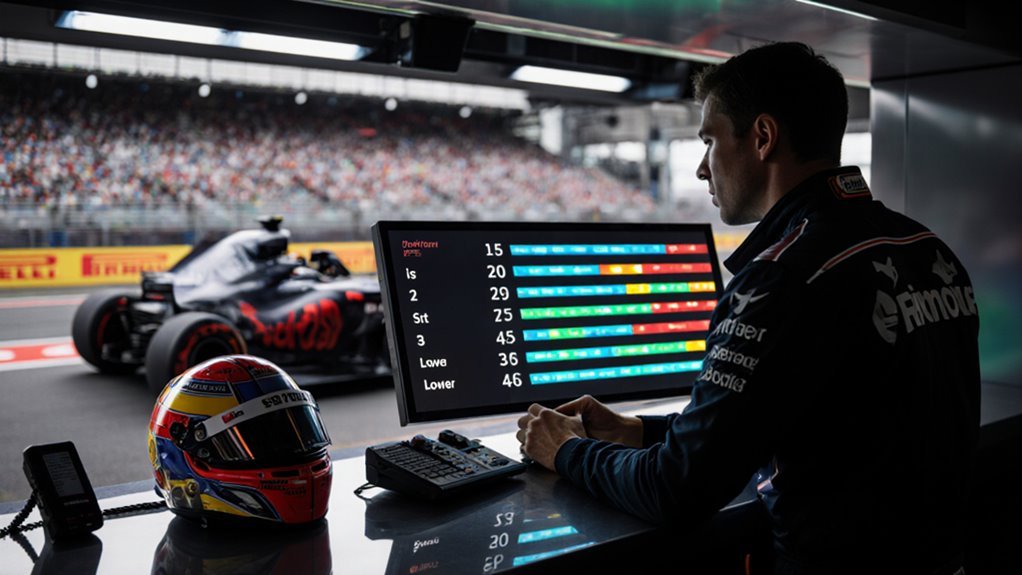

The F1 points system awards drivers based on finishing position, with the top 10 in a Grand Prix earning points toward the championship. Race winners receive the most points, and a single fastest lap in the top 10 adds an extra point. Sprint race results award fewer points but can shift standings quickly. Consistent high finishes often beat occasional victories for title hopes. Tiebreakers use countbacks of race wins, podiums, and other top finishes to separate drivers.
What Is the F1 Drivers’ Championship?
The F1 Drivers’ Championship is the prize every Formula 1 driver chases all season, because it goes to the one who earns the most points across the year’s Grand Prix races. You can regard it as your personal title, separate from the team award, so your own results matter even when you switch teams.
Since 1950, it’s shaped driver psychology and career trajectories, pushing you to stay sharp under pressure and keep believing after tough weekends. At season’s end, the driver with the highest total wins. In the event two drivers tie, Formula 1 uses a countback of wins, then second places, third places, and so on.
That history gives the championship real weight, and it helps you feel part of something bigger.
How F1 Points Work in a Race
Race per race, Formula 1 turns every finishing spot into something you can count. Should you cross the line foremost, you grab 25 points, then 18, 15, 12, 10, 8, 6, 4, 2, and 1 for the top 10.
That means your qualifying position matters, but it doesn’t lock your fate. In the race, your tyre strategy can lift you forward, while safety cars can tighten the pack and change the math fast. Weather impact can do the same, and that’s why fans feel every lap alongside you.
You don’t earn a fastest-lap bonus anymore, so the points come only from finishing strong. Over a season, those points stay with you even should you switch teams, helping you chase the title together with your crew.
How F1 Sprint Points Work
Sprint points add a fast little twist to an F1 weekend, and they can change the mood in just 100 kilometers. You watch drivers fight for quick gains, because the top eight score. The winner gets 8 points, then 7, 6, 5, 4, 3, 2, and 1 for eighth. That means every lap matters, and your team can build its season total in both championships without waiting for Sunday.
On Friday, Sprint Qualifying sets the grid, while the Sprint result doesn’t change the Grand Prix grid. Since there’s no mandatory pit stop, tyre strategy stays simple, but weather impact can still shake up the order. With more Sprint rounds now, you get more chances to enjoy a tense, high-energy points battle that feels like a bonus race.
How F1 Championship Tiebreaks Work
At the point two drivers end a Formula 1 season on the same points, things don’t stop there, because F1 uses a countback rule to break the tie. You get tie breakers explained by looking initially at race wins, then second places, thirds, and so on until one driver leads. This same method can decide any tied championship spot, so you’re never left guessing where you stand.
- More wins can lift you above a rival
- More runner-up finishes can save a season
- Sprint points stay part of the final total initially
- In a hypothetical deadlock, FIA rules might step in
That last step has never decided a champion. F1 applies the check only after every point is counted, so the result feels fair and clear.
Can F1 Champions Win Without Many Victories?
Yes, a Formula 1 champion can absolutely win the title without piling up lots of victories, because the points table rewards steady finishes just as much as raw speed. You can see this in champions like Mike Hawthorn and Keke Rosberg, who banked points week after week.
| Finishes | Title effect |
|---|---|
| Podiums | Big points |
| Top 5s | Strong base |
| Top 10s | Steady gain |
| Few wins | Still enough |
| Reliability | Championship edge |
That’s why points consistency matters so much. In the event you choose a reliability strategy, you stay in the fight even whenever others crash, break, or swing for risky wins. Since the system gives points down to 10th, your regular finishes can outrun flashier rivals. Thus you don’t need every trophy; you need a calm, dependable run that keeps you with your people in the title chase.
Who Are Formula 1’s Greatest Champions?
At the point you ask who Formula 1’s greatest champions are, you’re looking at more than just win totals, because titles like Michael Schumacher’s and Lewis Hamilton’s seven each set a huge standard.
You also need to weigh Max Verstappen’s dominant run and the way close fights, like Niki Lauda’s half-point win, can shape a legend.
As you compare these title winners, you’ll see that greatness in F1 comes from both record numbers and the pressure of winning at the moment every point counts.
Greatest Title Winners
Greatest champions in Formula 1 are rarely measured via trophies alone, because each title tells a story of pressure, skill, and nerve. You can spot the greatest champions through their title legacies, not just their tallies. Michael Schumacher and Lewis Hamilton each sit on seven, while Max Verstappen’s four straight crowns show how hard it’s to stay on top. Lando Norris’s 2025 breakthrough reminds you that an inaugural win can change everything.
- The UK leads with 11 champions.
- Its drivers have earned 21 titles.
- Niki Lauda won in 1984 as a result of half a point.
- Every crown joins 35 different winners.
When you follow these names, you feel the sport’s shared history, and you see how close every season can be.
Record Champions
Because Formula 1 crowns are so hard to win, the record champions stand apart for more than just numbers. You can see that in Michael Schumacher and Lewis Hamilton, the record holders with seven World Drivers’ Championship titles each.
Max Verstappen also belongs in that rare group, since he won four straight from 2021 to 2024 and entered 2025 as the reigning champion. Since 1950, only 35 drivers have reached the top, so every title feels precious.
You can also spot national dominance through the United Kingdom, which has produced 11 champions and 21 combined titles. Even the tightest fight, Niki Lauda’s half-point win over Alain Prost in 1984, shows how close greatness can be.
Championship Legends
Championship glory has a way of revealing more than talent alone, and Formula 1’s greatest champions show that in very different ways. You can spot greatness in clean stats, but you feel it in legacy rivalries and tense era comparisons.
- Michael Schumacher and Lewis Hamilton each own seven titles.
- Giuseppe “Nino” Farina became the inaugural official champion in 1950.
- Thirty-five drivers from 15 countries have won the crown.
- The UK leads with 11 champions and 21 wins.
You also see drama in close fights. Niki Lauda edged Alain Prost at half a point in 1984, and 2007 plus 2008 ended at one point.
Some legends dominate with many wins, while others, like Keke Rosberg and Mike Hawthorn, grab glory through steady points and nerve.
What Happens When Teammates Fight for the Title?
At the point two teammates end up fighting for the Drivers’ title, the garage can turn into the most tense place in Formula 1. You’ll feel team orders and intra team dynamics shape every call. Often, the team backs the driver with the best points, more wins, or stronger odds, so pit stops and strategy can swing fast.
That can leave you supporting one side, even though both drivers want the crown. History shows how hard this gets, because a teammate’s move can decide a race, and sometimes a whole season. Yet some teams keep things equal, letting both drivers race hard and earn their place.
Should the title stay tied, countback matters, so each win, second, and third becomes huge. In that fight, your results change your status, too, and the whole team feels it.
How Teams Choose a Lead Driver
Team bosses usually pick a lead driver through looking at two things initially: who’s in the strongest form right now, and who already has the bigger championship resume.
That’s how team hierarchy starts, and you’ll often feel it in the garage. A world champion or a driver on a hot streak can set the pace, while the other side of the garage might accept a support role.
- You’ll see strategy bias once the title fight tightens.
- Equal treatment can keep both drivers pushing hard.
- Driver development matters provided a younger teammate grows fast.
- Strong results can stop any automatic demotion.
Sometimes the choice is clear, and sometimes it shifts quietly.
Either way, you’re part of a team that wants the best shot at points, esteem, and trust.
What Is a Standard F1 Weekend?
A standard Formula 1 weekend usually feels fast even before the cars fire up, because the schedule packs a lot into just three days. You’ll get FP1 and FP2 on Friday, then FP3 and qualifying on Saturday, and the race on Sunday.
| Day | Track time | What you do |
|---|---|---|
| Friday | FP1, FP2 | Check systems and trial longer runs |
| Saturday | FP3, Qualifying | Fine-tune before parc fermé |
| Sunday | Race | Fight for points |
Your Friday schedule starts the rhythm, and parc fermé locks the setup after Saturday’s final practice. Qualifying cuts the field in three rounds, so each lap matters. Cars also collect huge telemetry, and rookies get FP1 chances twice a season, which keeps the paddock connected and growing.
How an F1 Sprint Weekend Works
On a Sprint weekend, you’ll see a shorter Friday and a new race format that changes how the whole event flows.
You get one practice session, Sprint Qualifying, and then a Saturday Sprint that sets up extra championship action.
Because the Sprint awards points to the top eight finishers, every lap can matter for the Drivers’ and Constructors’ standings.
Sprint Weekend Format
As soon as an F1 Sprint weekend arrives, the whole rhythm of the event changes, and you’ll notice the pressure build much faster than usual. In the Sprint format, your Weekend schedule gets packed with more action and less downtime, so every session feels crucial.
- Friday starts with FP1, then Sprint Qualifying
- SQ1 lasts 12 minutes, SQ2 lasts 10, and SQ3 lasts 8
- Saturday brings the Sprint, a short race about 100 km long
- Later on Saturday, traditional Qualifying sets Sunday’s grid
Because Sprint weekends happen only at selected rounds, they feel special whenever you’re part of them. You lose some FP2 and FP3 time, but you gain more competition and a tighter flow.
That faster pace makes the whole event feel shared, like you’re in the heart of the action with everyone else.
Sprint Points Scoring
Sprint weekends don’t just change the schedule, they change how points can land, too. You watch Friday’s Sprint Qualifying set the grid for Saturday’s 100 km Sprint, then you see the regular qualifying session decide Sunday’s Grand Prix order.
Because the Sprint is short and has no mandatory pit stop, your Sprint strategy and Tyre management matter right away. Since 2022, the top eight finishers score points on Saturday, with 8 for opening and 1 for eighth, so every place feels worthwhile.
That shift from the old 3-2-1 setup gives you more chances to build your total across selected race weekends. Whenever you follow these sessions, you’re not just watching speed, you’re tracking a real points fight with room for bold moves and smart recovery.
Why F1 Practice And Qualifying Matter?
Because Formula 1 is decided via tiny margins, practice and qualifying matter just as much as the race itself. During FP1 to FP3, you trial race pace, tyre strategy, and qualifying speed, so your practice setup gets sharper each session. FP2 usually shows long-run rhythm, while FP3 helps you rehearse short laps before parc fermé locks the car. That matters because you can’t easily fix mistakes later, and one bad run can hurt your grid spot.
- You learn tyre wear before the pressure rises.
- You time pit exits to dodge traffic.
- You shape balance for one flying lap.
- You fight for Q3, pole, and cleaner starts.
Qualifying then turns that work into a grid position. In Q1, Q2, and Q3, every second counts, and clear air can make your lap feel like a lifeline.
Frequently Asked Questions
How Many Points Does the Race Winner Receive?
The race winner gets 25 points, simple as that, and you’re right there with the front runners. You’ll see those winner points light up the standings, giving you a clear sense of who’s leading the pack.
Do All Top Ten Finishers Score Points?
Yes, you do: the top ten finishers score points, so every position matters. Your pit strategy and tyre degradation can make you feel part of the fight, because one place can change everything.
Are Sprint Race Points Separate From Grand Prix Points?
Yes, they are separate, right? You will see sprint strategy affects a different score from the Grand Prix, and each can earn separate trophies. You belong in the action, but the points do not merge, so every race matters.
What Decides a Title if Drivers Are Tied on Points?
You use the countback rule: whoever has more race wins takes the title. If that is still tied, you compare second places, then third places, and so on until one driver leads.
Can Teams Score Points With Both Cars?
Yes, you can score points with both cars, and it is no coincidence that your team strategy often depends on it. Both drivers can add to constructor rivalry, helping you feel part of the fight.