

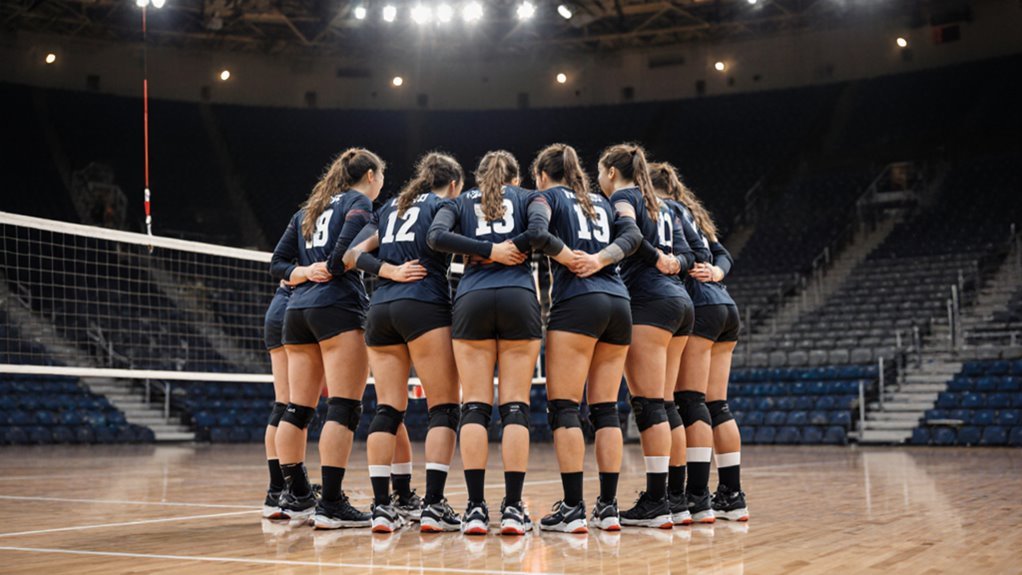

A standard indoor volleyball lineup has six players on the court at a time. Teams often carry additional players on the roster to cover rotations, substitutions, and injuries. Beach volleyball uses two players per side, while sitting volleyball features five per side in many competitions. Snow volleyball typically fields three players per team on court. Squad size and roles shift with each format, affecting strategy and roster construction.
How Many Players Are on a Volleyball Team?
A volleyball team usually has six players on the court at once in standard indoor play, but the full team is often larger so everyone can rotate, rest, and develop.
You’ll usually see practice rosters built around 12 players, which helps you scrimmage evenly and get real chances to sub in. On JV teams, 12 to 14 players is common, so you can grow together without feeling lost in the crowd.
Varsity rosters often hold 10 to 14 players, and many programs opt for 12 or 13 to reward effort and commitment.
Novice teams might carry up to 16 players, too. That size can trim court time, but it still builds mental toughness and team chemistry whenever you show up ready and support each other.
Why Six Players Is the Standard
Six players is the sweet spot in indoor volleyball because it gives each team enough hands to cover the whole court without making the game feel crowded or slow. You get strong team interactions, since everyone has a clear job and still relies on one another.
- Three players guard the net and attack.
- Three players handle deeper defense and passing.
- The 3-meter line keeps roles balanced.
- Rotational strategy stays simple and fair.
Because each rally allows three contacts, you can pass, set, and spike with purpose. That rhythm keeps the game fast and fun.
Six also fits the classic six court spots, so serving order and movement stay easy to track. As a result, you can build trust, move together, and feel like you belong on the floor.
How Many Players Are on a Volleyball Roster?
You’ll usually see volleyball rosters land around 12 to 14 players, which gives your team enough depth without making practice feel crowded. Should you’re on a novice team, you could even see rosters closer to 16, whereas varsity teams often stay near 10 to 14. The best number really depends on your team’s goals, since more players can mean more support, but it can also mean fewer minutes for each person.
Typical Roster Sizes
- 12 players often fits practice best
- 12 to 14 players works well for JV
- 10 to 14 players is common for varsity
- 16 players can suit novice teams
Some programs add a couple more spots to reward commitment, but they still keep roles clear.
That way, you can grow, compete, and belong without feeling lost in the crowd.
Varsity Vs. Novice Rosters
As you compare varsity and novice volleyball rosters, the biggest difference is what each team is trying to do with its players.
On novice teams, you could see everyone who tries out stay on the roster, sometimes up to 16 players, because the goal is learning and match time for all.
On varsity, you’ll usually find 10 to 14 players, with 12 often giving the best practice depth and clean rotations.
JV sits in the middle, often 12 to 14, so you can play hard and still keep more athletes involved.
Some programs keep 13 or 14 spots to reward commitment, but Coach expectations stay clear.
Should you be on the edge, you may play less, yet you still belong, and your role can matter.
What Each Volleyball Position Does
You’ll usually notice the setter initially because they run the offense and place the ball where hitters can attack cleanly.
From there, your front row attackers, like the outside hitter, opposite hitter, and middle blocker, turn those sets into points with fast, smart swings.
Even though each role looks different, they all work together so you can see how a team stays balanced and dangerous on the court.
Setter Responsibilities
The setter runs the offense, and that job can feel a lot like being the team’s calm brain in the middle of all the action. You handle the second contact, spot your hitters, and choose the best set fast. With tempo variation and communication leadership, you help everyone trust the play and stay in sync.
- Read the block and defense
- Pick quick, high, or back-row sets
- Keep your location sharp, often within centimeters
- Move quickly after the serve for clean court position
Whether you set from the front row or back row, you guide the rally with steady decisions. Because your hands touch the ball so often, your timing matters. Whenever you stay clear and confident, your teammates feel it too, and the whole side starts to click together.
Front Row Attackers
Front-row attackers turn the setter’s choices into points, so this is where the rally starts to feel dangerous for the other team. You can count on your outside hitters to swing from the left front, pass serve receive, and still take big high balls when they move to the back.
Your opposite gives you power from the right front and helps guard against the other team’s best outside hitter. Your middle blocker keeps the pace fast with quick attacks and anchors blocking schemes across the net. Sometimes your setter even sneaks in a dump or hits in a 6-2 system. Should your rotation need extra strength, a front-row sub can step in and give your team the edge you want.
How the Libero Changes Roster Needs
Because the libero can keep coming in for back-row players without using a substitution, roster planning gets a lot easier and a lot more strategic. You can build around libero specialization and protect your defense depth while still leaving room for hitters.
- You usually carry one main libero.
- You often add a backup for coverage.
- You keep taller players focused up front.
- You let skilled passers anchor the back row.
That setup helps you stay balanced under NCAA, NFHS, and USA Volleyball rules. Since the libero can replace back-row players again and again, you don’t need to overload your bench with extra defenders. Instead, you can roster more front-row options and still feel secure in serve-receive.
At higher levels, that often pushes your group toward about 12 players, which gives you flexibility without crowding your lineup.
How Many Players Are on a Novice Team?
On a novice volleyball team, roster size usually leans toward inclusion, not pressure. You’ll often see every player who tries out stay on the team, because coaches want you to learn the game and feel like you belong.
A practice roster of 12 works well, but teams can grow to 16 players and still function. That bigger group isn’t perfect, yet it’s workable whenever the goal is experience, rather than a perfect win record.
Coaches keep equipment needs and parent involvement in mind, since more athletes mean more gear, more support, and more planning. Even assuming playing time isn’t equal, you still get court time, practice reps, and a real chance to grow. That’s the heart of a novice team.
JV Volleyball Team Size and Roles
On a JV volleyball team, you’ll usually see about 12 to 14 players, which gives coaches enough depth for subbing and still leaves room for you to get real court time.
Since JV is built for growth, your coach will try to give everyone meaningful minutes while also keeping the strongest lineup on the floor as the match gets tight.
You’ll also get set roles like setter, outside hitter, middle blocker, or libero, so you can build skills and show you’re ready for varsity later on.
Typical JV Roster Sizes
A typical JV volleyball roster usually holds 12 to 14 players, and that size works well for a team that needs both learning and real game action.
With that range, you get strong roster balance and a clear development focus, so you can grow with your teammates.
- 12 players lets you split into two six-player groups.
- 13 players adds one extra option for practice and matches.
- 14 players gives room for serving or defensive specialists.
- Coaches can build roles while keeping the gym competitive.
Because JV is about growth, you’ll often see more chances to learn systems, evaluate skills, and feel part of the group.
Starters might still play more, but you won’t feel lost on the bench.
Playing Time For Everyone
JV volleyball usually feels most fair whenever coaches give everyone a chance to play, even though the minutes aren’t split perfectly. You’ll usually see 12 to 14 players sharing time, and that size lets you belong while still getting real court chances. Coaches use rotation strategies to move you in and out between sets, so the strongest group can compete and others stay ready.
| What you could get | Why it matters |
|---|---|
| Shorter shifts | You stay involved |
| Defined bench culture | You feel included |
Some players start more, but every rostered player should see the floor. Should you be on the bench, clear talk at tryouts helps you know your role and stay motivated. That way, you can cheer hard, prepare well, and trust your moment will arrive.
Roles And Player Development
Once the roster is set, the next question is who does what and how each player grows in the role. On a JV team, you usually share 12 to 14 players, so you can build team chemistry while still giving everyone a real chance to learn.
- You might start as a setter, outside hitter, or middle blocker.
- You can also grow as a defensive specialist or libero.
- Serving and situational spots teach pressure control.
- Bench roles still matter, because readiness builds trust.
Coaches use these jobs to match your current skills with the team’s needs. That setup supports skill progression and helps you feel included, even should you’re not starting yet.
Provided the roster runs a little larger, clear expectations keep things fair and focused. You’re not just waiting your turn. You’re learning how to fit, contribute, and belong.
Varsity Volleyball Roster Size
Varsity volleyball rosters usually land somewhere between 10 and 14 players, and 12 is often the sweet spot for a team that wants strong practices without crowding the bench.
With that number, you get roster flexibility and better practice efficiency, because drills can run in even groups and everyone stays active. You can build a starting six and still keep six subs ready for specialized jobs like serving, defense, or front-row help.
Some teams carry 13 or 14 players to reward hard work and add depth, even though a few athletes see fewer match minutes.
Provided you’re trying out, know that every roster spot matters. Coaches should explain roles clearly so you feel included, valued, and ready to help upon being called.
Beach Volleyball Team Size
Beach volleyball looks very different from indoor volleyball, especially whenever it comes to team size. You’ll usually step onto the sand with just one partner, and that tight setup builds real court chemistry.
In official FIVB and Olympic play, you and your teammate form a 2 vs. 2 team, with no in-match substitutions. That means your full roster is often only the two of you, plus perhaps an alternate or coach on paper.
- You both cover every shot.
- You lean on sand strategy.
- You call each play together.
- You trust quick teamwork.
Because of that, every move matters, and you can feel like a true unit.
Recreational beach games might use more players, however standard beach volleyball keeps it simple and close.
Sitting Volleyball Team Size
Sitting volleyball teams use six players on the court at one time, and that setup keeps the game fast, close, and demanding.
You’ll usually see three athletes up front and three in back, working inside a 10 by 6 meter court.
Because there’s no libero, you and your teammates share defense through rotations and smart substitutions.
Competitive rosters often carry 10 to 12 players, so you’ve got help as fatigue sets in or roles shift. That depth matters even more alongside adaptive equipment and classification rules, which shape fair play and keep every athlete ready to contribute.
Men’s and women’s net heights also change front-row jobs, so blocking and quick reactions matter.
With the right group, you can feel supported, strong, and fully part of the team.
Snow Volleyball Team Size
Snow volleyball keeps things simple and intense, with three players on the court for each team at one time.
You’ll usually see 4 to 6 players on a roster, so you’ve got support whenever the cold bites hard.
Because there’s no libero, everyone shares every skill and helps the group stay steady.
That teamwork feels strong and welcoming.
- You can train with altitude training for better stamina.
- You’ll want thermal gear to stay warm and ready.
- You’ll use snow specific tactics to read bounce and wind.
- You’ll value rapid substitutions whenever fresh legs matter.
Organizers set the final roster rules, but most international events let you carry one or two extras.
How Substitutions Shape Roster Size
How substitutions shape roster size comes down to one simple truth: the more often a coach can swap players in and out, the more choices that coach needs on the bench.
In your substitution strategy, FIVB rules keep things tighter because you get six subs per set, and each player can enter once. That usually means a smaller, steadier group.
In contrast, NCAA-style play gives you more room, so bench management gets bigger and busier.
You’ll also see rotation timing matter more whenever fatigue mitigation is a goal, because fresh legs can keep your team sharp.
On varsity, 10 to 14 players often feels right.
On JV or novice squads, you might see 14 to 16, since everyone needs court time and room to grow together.
How to Pick the Right Volleyball Roster
A good volleyball roster starts with the kind of team you want to build, because the right number of players can make practice smoother and game day less stressful. You want a roster that fits your level, keeps team chemistry strong, and supports injury prevention whenever bodies need rest.
- Pick 12 for balanced practices and fair scrimmages.
- Use 12 to 14 for JV so you can rotate developing players.
- Choose 10 to 14 for varsity, with 12 as the sweet spot.
- Go up to 16 for novice teams whenever you’re focused on inclusion.
If you carry 13 or 14, tell players ahead of time about bench roles and value every job. That way, you build trust, keep spirits up, and help everyone feel like they belong on the court.
Frequently Asked Questions
How Many Players Does a Volleyball Team Have?
You usually have six players on court, while teams often roster 10 to 14 total. You will rotate through team positions, so everyone belongs and contributes. Beach volleyball uses two players per side, but indoor play centers on six.