
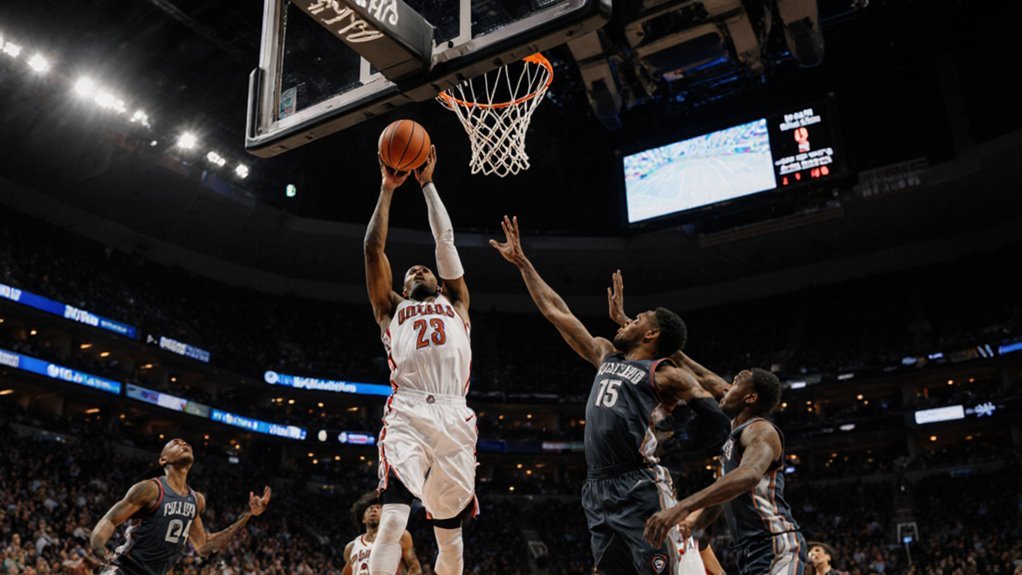

A buzzer beater is a basketball shot released before the game clock shows 0.0 that counts if the ball is already in flight. Such shots can win a game or tie it and force overtime. Officials determine validity by reviewing clock and release timing, often using replay and audio cues. Physical arenas and broadcast setups affect how tight the timing appears. Moments like these create instant, high-stakes drama that can change a team’s fate in a single second.
What Is a Buzzer Beater?
A buzzer beater is one of basketball’s most thrilling moments, because it happens right as the clock hits 0.0 and can flip a game in a single breath. You’re watching a shot that leaves the hand before time runs out, so clock mechanics matter a lot.
At the instant the ball drops, you feel the whole gym change at once. Teammates rush in, and crowd reactions swing from gasps to cheers in seconds. Leagues use 10th-of-a-second displays, instant replay, and bright lights on the backboard or table to check the release. That’s why the moment feels so tense and shared. You’re not just seeing a shot. You’re joining a surge of hope, suspense, and esteem with everyone else in the building.
How a Buzzer Beater Counts
At the moment the shot goes up at the buzzer, the real question is whether the ball left the shooter’s hands before the clock hit 0.0. Your release timing decides everything, and officials check it with care. In case the clock is clear, they use that display initially.
Whenever it’s hard to see, they lean on official procedures, including the red backboard light, the horn, and instant replay where the league allows it. That extra review can feel tense, but it helps make the call fair for everyone in the gym.
In some games, the original ruling stays because no replay exists, so the primary whistle matters more. Still, whenever video and timing line up, the basket counts, and your shot belongs.
Buzzer Beaters vs. Game-Winning Shots
Even though people often use them like they mean the same thing, a buzzer-beater and a game-winning shot are not always the same play. You can hit a buzzer-beater and still only tie the game, which means overtime, not victory. A game-winner, though, puts your team ahead for good. That difference changes momentum swings and the psychological impact on both sides.
| Play | Timing | Result |
|---|---|---|
| Buzzer-beater | Before 0.0 | Can tie or win |
| Game-winner | Any late moment | Gives final lead |
| Both | Before horn | Wins the game |
How the Shot Clock, Horn, and Replay Work
Whenever you watch a buzzer-beater, the initial thing that matters is whether the ball leaves your fingers before the clock hits 00.0.
Provided the display is hard to see, officials can turn to the backboard lights and the horn to check the timing.
And assuming the call still feels close, replay can review the release frame by frame to help settle it.
Shot Clock Expiration
A buzzer beater only counts provided the ball leaves the shooter’s fingers before the clock hits 00.0, so the tiny moment of release matters more than the dramatic sound of the horn. On the shot clock, you watch the last tenths, and the reset mechanics matter whenever a new possession starts. Should a premature horn sound, officials check rule implications before they celebrate or wave it off.
- You’ll usually trust the visible clock initially.
- Then replay or the backboard light can settle doubt.
- In case venue boards disagree, the official feed wins.
When timing looks messy, you’re not alone in the confusion. At higher levels, replay helps protect you from bad guesses. At lower levels, the call might rest on what everyone can see, which can feel tense but fair.
Horn And Release
Near the horn, timing gets very human very fast, because one tiny release can decide everything. You watch shot timing with the clock initially. Should the display shows tenths, your shot counts only when the ball leaves your fingers before 00.0. Whenever that number is concealed, officials turn to the red or LED backboard or table light instead. The horn matters, but it’s only a backup clue, since sound can lag a little.
In games with replay, refs can compare video frames to the clock or light and make the call clearer. Suppose you’re playing in a gym without those tools, your release mechanics and the on-floor call usually settle it, so trust your move and stay ready.
Replay Verification Rules
Because the last second can feel like forever, replay rules step in to give everyone a fair answer on a buzzer-beater. You’re not left guessing, because the timing hierarchy starts with the game clock, then the red backboard light, and then the horn. In NCAA play, the tenth-of-a-second clock readout usually tells the story. Should it’s unclear, officials check video and use the replay protocol to see whether the ball left your shooter’s hand before the light came on.
- Clock first: release before 00.0 counts.
- Light next: video can confirm the shot beat it.
- Horn last: in case signals clash, replay settles it.
When everything still feels close, the crew can’t just wish for clarity. Unless replay can’t prove the shot beat the clock, your on-floor call stands.
Famous NCAA Buzzer Beaters
College basketball has given fans some of its wildest moments as the clock hits zero and hope turns into celebration in one instant.
You recall NC State at the moment Lorenzo Charles grabbed Dereck Whittenburg’s airball and dunked at the horn to shock Houston in 1983. Then you can feel the chill of Christian Laettner’s 17-foot jumper, set up by Grant Hill, that beat Kentucky in 1992.
Later, Kris Jenkins buried a final-buzzer three for Villanova in 2016, and Jalen Suggs answered UCLA with a deep Final Four dagger in 2021.
Most recently, Lamont Butler lifted San Diego State past Florida Atlantic in 2023. These underrated finishes also show how coaching decisions can shape the last possession, and they remind you that you’re never alone in the roar.
NCAA Tournament Buzzer Beaters
As you consider NCAA Tournament buzzer beaters, you envision Final Four drama, title-winning shots, and the kind of upsets that stay with you for years.
You can see Christian Laettner’s turnaround, Kris Jenkins’ title-clincher, and Jalen Suggs’ deep winner because each one turns one shot into a whole memory. And once the horn sounds for good, you know these moments don’t just end games, they can change an entire tournament run.
Iconic Final Four Moments
Few things in sports hit harder than a Final Four buzzer beater, especially because the pressure feels almost too big for one shot. You feel March magic whenever the clock shrinks and the crowd holds its breath. This buzzer tradition brings fans together fast.
- In 1983, NC State’s Lorenzo Charles grabbed an airball and dunked at the horn to stun Houston 54-52.
- In 2021, Jalen Suggs raced coast to coast and buried a three to lift Gonzaga past UCLA 93-90.
- In 2023, Lamont Butler hit a jumper at the buzzer to send San Diego State past FAU 72-71.
These shots show why you stay glued to the final seconds. You never know at what moment one clean look will turn nerves into joy.
Championship-Clinching Shots
Those last-second Final Four shots set the stage for something even bigger, because a buzzer beater can do more than win a game. In March, you feel the whole crowd shift as one shot changes everything.
Lorenzo Charles, Kris Jenkins, Jalen Suggs, and Lamont Butler all turned pressure into joy, while Christian Laettner’s jumper showed how one pass can spark a finish with huge momentum swings. These shots don’t just decide a score; they shape your team’s legacy impact and stay with fans for years.
Once the horn sounds and the ball drops, you share that rush with everyone in the arena. That’s why these championship-clinching moments matter so much. They give you prideful satisfaction, hope, and a memory that feels bigger than basketball.
Memorable NCAA Upsets
NCAA tournament upsets can flip in a blink, and buzzer beaters make that shock feel even bigger. Whenever you watch these moments, you feel part of the crowd, even from home.
- Paul Jesperson’s half-court shot stunned Texas and sparked real Bracket chaos.
- Lorenzo Charles’ tip dunk gave NC State a title and sealed a true Cinderella finishes story.
- Kris Jenkins’ three-pointer lifted Villanova past North Carolina and turned a close game into joy.
You also recall Jalen Suggs beating UCLA at the buzzer in the Final Four, and Christian Laettner’s famous turn, catch, and shoot against Kentucky after a wild overtime. These shots don’t just win games. They give you goosebumps, build shared memories, and make every underdog fan feel seen.
Iconic NBA Buzzer Beaters
Iconic NBA buzzer beaters hit you right in the chest because they end games in the exact instant that hope feels stretched thin. You feel clutch psychology at work once the ball hangs in the air and your whole group leans in together. Then stadium acoustics turn every bounce, gasp, and scream into a shared heartbeat. Kawhi Leonard’s four-bounce winner for Toronto and Damian Lillard’s 37-foot dagger to end Oklahoma City’s run show how one shot can freeze a crowd and lift a city.
These moments matter because they land at the horn, not after. You also recall Kobe Bryant, Kevin Durant, and LeBron James making time vanish in regular season and playoff pressure. As the shot falls, you’re not watching alone. You belong to the roar.
Buzzer Beaters By Superstars
Superstars don’t just score a lot, they also know how to end a game once the clock starts to feel cruel. Whenever you watch LeBron James, Stephen Curry, Luka Dončić, Kawhi Leonard, or Dirk Nowitzki, you see clutch mechanics built on calm feet, quick reads, and trust from teammates. Their celebrity narratives matter too, because fans feel part of those huge moments.
- LeBron’s overtime winner in 2018 showed power and poise.
- Curry’s initial game-winning buzzer-beater in 2022 showed smooth timing.
- Luka and Kawhi keep giving you late-game proof that pressure can become your stage. Dirk’s 2014 jumper still feels personal to Dallas fans, because it ended with a clean, earned win.
Long-Range Buzzer Beaters
Long-range buzzer-beaters take the drama and stretch it to the edge of the floor. You watch a shot fly from well beyond the arc, sometimes from half-court or deeper, and it has to leave the shooter’s hand before 00.0. Whenever it drops as the buzzer sounds, your crowd gets half court theatrics that feel unreal. These moments are rare, but they can flip a game or force overtime, just like Devonte’ Graham, Jeremy Lamb, or Damian Lillard did.
Because the odds are so low, you’ll often see a heave or a desperate inbounds pass instead of a set play. Still, percentage analytics can’t erase the joy. Replay, clock displays, and backboard lights help settle any doubt, so you know the magic is real.
Putbacks, Tips, and Inbound Finishes
After those deep heaves, the wildest buzzer-beaters often happen right under the rim or on a quick inbound play. Whenever you track the ball, you can feel the crowd lean in with you. On a putback, you use tight putback mechanics: crash the glass, tip or dunk the miss, and beat 0.0.
- Josh Smith did it with a putback dunk.
- Mike Dunleavy slipped in a tip for a win.
- Tyson Chandler scored on a fast inbound finish.
With inbound timing, you’ve got almost no room to breathe, so you need a clean catch, a fast touch, or a sharp tip. Officials check the clock, the LED lights, and replay to see whether the ball left your hands in time. That’s why these plays feel so tense, and why you belong in the thrill once they work.
Buzzer Beaters Beyond the NBA and NCAA
Beyond the NBA and NCAA, a buzzer-beater still brings the same rush, but the way officials judge it can change a lot from one league to the next. In FIBA games and many European leagues, you usually see LED backboard lights, replay checks, and clear officiating differences that help show whether the ball left your hand before 0.0. EuroLeague clubs have leaned hard into technology adoption, and that has cut down on old arguments.
At lower levels, though, you perhaps only have the scoreboard, the horn, and the referee’s signal. That can make a huge play feel even bigger, because everyone in the gym is watching the same few clues. Sometimes, provided timing errors show up, officials even restore a bit of time, so your shot still gets a fair look.
Why Some Buzzer Beaters Are Hard to Call
Some buzzer beaters are hard to call because the clock and the shot don’t always seem to agree, and that split second can change everything. You can watch the ball leave a hand, but the game still needs proof that it left before 00.0. That’s where timing technology matters, and where human error can creep in.
- Officials check the 10th-of-a-second display initially.
- Then they look at the backboard or table red lights.
- Should it be necessary, they use replay to sort out the release.
On lower levels, you mightn’t get replay or LED lights, so the call can rest on one view and a fast whistle. Even ribbon boards can disagree with the backboard clock, which makes your heart sink a little whenever everyone’s waiting to belong to the same answer.
Why Buzzer Beaters Feel So Electric
A buzzer beater feels electric because it turns a whole game into one sharp, unforgettable moment. You feel the crowd lean in, then burst together as the shot drops. That shared shock gives you an emotional payoff that lasts long after the horn.
| Signal | Meaning | Feeling |
|---|---|---|
| Clock hits 0.0 | Final chance | Tension |
| Red lights flash | Shot counts | Relief |
| Replay starts | Call gets checked | Suspense |
| Ball goes in | Result flips | Joy |
With so little time left, you need quick catches, strong spatial awareness, and a calm release. That’s why the play feels bigger than one basket. You’re not just watching points change. You’re joining a group that gasps, hopes, and celebrates at once.
Basketball’s Most Iconic Buzzer Beaters
You can’t talk about buzzer beaters without pondering about the ones that changed history in a single instant. From Lorenzo Charles’s title-winning tip-in to Kris Jenkins’ championship three, these shots show how one clean look can flip heartbreak into joy. Next, you’ll see why plays from Christian Laettner, Jalen Suggs, and Lamont Butler still linger with fans long after the final horn.
Historic Game Winners
Historic game winners are the shots that make basketball feel bigger than the scoreboard, because they turn a tight game into a memory people keep for years. Whenever you watch them, you feel clutch psychology at work, and arena acoustics seem to rise with every bounce.
- Lorenzo Charles turned NC State’s 1983 airball into a dunk and a title.
- Christian Laettner sank his 17-foot jumper to stun Kentucky in 1992.
- Kris Jenkins buried the final horn three to win Villanova the 2016 crown.
These moments connect because you’re not just seeing points, you’re sharing a pulse with the whole crowd. As soon as you watch Jalen Suggs and Lamont Butler later gave you that same thrill, showing how one clean shot can bring people together fast.
Iconic Final Buzzer Moments
As the clock hits zero, basketball can feel almost unreal, because a single shot can flip fear into joy in a single breath. You’ve felt that hush, then the roar, whenever crowd psychology takes over and everyone leans toward the rim.
Kris Jenkins’ title three, Laettner’s 17-foot dagger, Lorenzo Charles’ tip-in, Jalen Suggs’ bank shot, and Lamont Butler’s winner all show how fast hope can turn into history.
Each play fits the same broadcast rituals too: the frozen replay, the rising voice, the stunned silence, then the burst of sound. Whenever you watch these moments, you’re not just seeing points. You’re joining a shared memory, where your heartbeat matches the arena and every fan feels like they’re part of the same final, unforgettable second.