

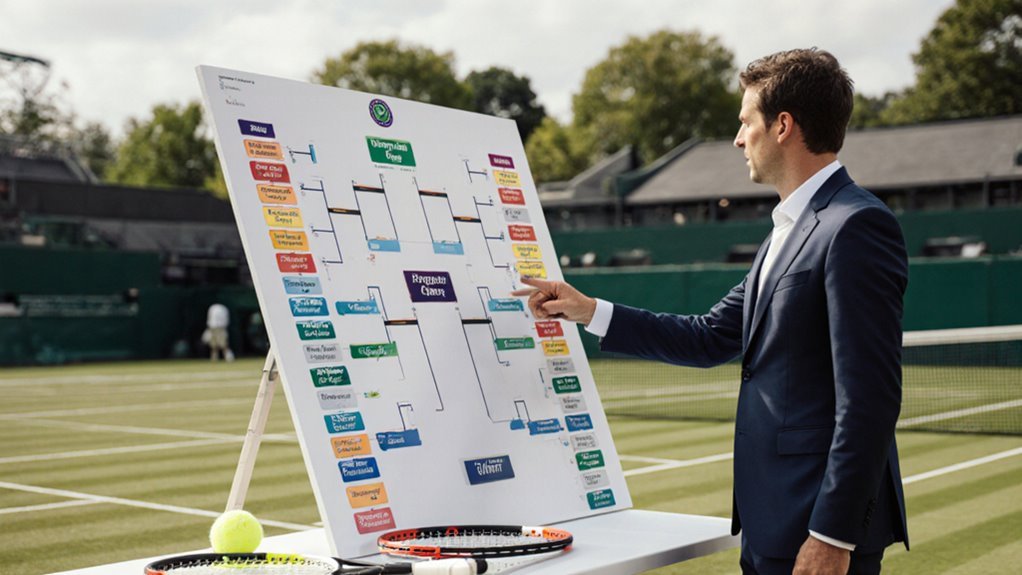

Wimbledon seeds players using a special formula rather than relying solely on official rankings. The system adjusts rankings based on grass-court results from the past 12 months and a longer grass-court performance window. Seeded players are placed so top contenders avoid each other until later rounds. This arrangement protects grass specialists and reflects surface performance more than a standard ranking list. The result is a draw tailored to the unique demands of grass-court tennis and Wimbledon tradition.
What Is Seeding in Tennis?
Seeding is tennis’s way of giving the best players a fair lane through the draw. You can consider it as a ranking tag that helps a tournament spread strong players out, so you’re less likely to see them clash prematurely. At Grand Slams, the top 32 players usually get seeds, and No. 1 means the highest-ranked entrant.
Once the draw is set, those seed numbers stay fixed. This matters for player psychology because it can ease pressure and build confidence. It also shapes match momentum, since a strong seed might face a smoother path before the biggest battles.
Most events use tour rankings, and Wimbledon now does too, so you get a draw that feels clear, balanced, and fair.
How Wimbledon Seeding Is Set
At the time Wimbledon sets its draw, it uses a clear and strict process so players and fans know where everyone stands. You’ll see the 32 highest-ranked entry players seeded in exact order, based on the ATP and WTA rankings published the Monday before the tournament. Since 2021, men’s and women’s singles follow those tour rankings only, which keeps seeding fairness easy to follow.
Earlier, the men’s draw used a grass adaptation formula, but that special tweak is no longer the norm. Should a higher-ranked player withdraw before the draw, the seeds can shift, and you might see another entrant move up. Wimbledon also seeds doubles, mixed doubles, and wheelchair and quad events the same way, so each field feels organized and welcoming.
Why Wimbledon Uses Seeds
Wimbledon uses seeds to keep the draw fair and exciting, so the strongest players don’t knock each other out too prematurely. You get a bracket that feels balanced, and that helps with player protection as well as tournament predictability.
- Seeds spread top players across the draw.
- You’re more likely to see big matches later.
- Grass-court form can still matter.
This system also gives you a clearer path to follow, which makes each round easier to enjoy with the rest of the crowd. Because seeds are fixed once the draw is set, they help Wimbledon place players so the top names usually meet deeper in the event, not on day one.
That means you can settle in, back your favorites, and feel part of the story as it builds.
How the Wimbledon Draw Protects Seeds
The draw card is where Wimbledon quietly does its best work, because it gives the top seeds a clear path without making the event feel locked up too prematurely. You can see the seed protection in the 128-player bracket below:
| Seed band | Draw effect |
|---|---|
| 1 to 4 | Opposite halves and separate quarters |
| 5 to 8 | Different one-eighths |
| 9 to 32 | Later-round protection by band |
That setup keeps draw integrity strong. You’re protected from another seed until the third round provided you sit in 17 to 32, or the fourth round provided you’re in 9 to 16. Then the exact spots are drawn via lot inside each band, so luck still has a say. Because the seed list is fixed from the latest rankings, you receive a fair, familiar structure without losing the thrill.
Why Wimbledon Has 32 Seeds
A simple 32-seed setup gives Wimbledon the balance it needs between fairness and drama. You get a draw that feels open, yet seeded stars still stay apart long enough to build excitement. With 32 seeds, each section of the 128-player bracket holds one seed, so protection stays clear and easy to follow. That also matches the Grand Slam standard used across tennis since 2001, which helps you feel at home whenever you compare events.
- It supports seeding psychology by lowering initial upset stress.
- It enhances commercial impact by protecting marquee matchups.
- It fits the depth of today’s game without crowding the draw.
How Men’s Wimbledon Seeds Are Ranked
Men’s Wimbledon seeds don’t follow the usual ATP list alone, and that’s where things get interesting.
You start with the ATP Entry System Position published the Monday before the event, then Wimbledon adjusts it for grass strengths. It adds all the points you accumulated on grass in the last 12 months, then adds 75% of your best grass result from the 12 months before that. This grass-adjusted total can lift you above players who sit higher in the ATP table, especially should your serve effectiveness and movement fit the surface.
That’s why a grass specialist can feel like a real threat in the draw. Wimbledon used this formula from 2002 to 2019, then returned to ATP rankings alone for men’s seeds in 2021.
Why Women’s Wimbledon Seeding Differs
You’ll notice women’s Wimbledon seedings now follow the WTA rankings initially, so the top 32 players are placed in exact ranking order at the cut-off.
Before 2021, though, the All England Club could still make a few committee tweaks for strong grass-court players or returning stars. That grass-court exception is gone now, which makes the women’s draw feel more consistent and easier to follow.
Ranking-Based Seeding
Since 2021, Wimbledon has kept the women’s singles seeding system much simpler than many fans expect, because it now follows the WTA rankings alone. You get 32 seeds, and each one lines up with the exact ranking at the cut-off Monday before the event. That means your place depends on results, not a special grass-court formula.
- Strong grass performance still matters in matches, just not in the seed order.
- Ranking volatility can shift you quickly, so one big week can change your path.
- Should someone withdraw after the cut-off, you might see a seed that feels higher than the live ranking.
This setup helps you understand the draw and feel part of the same orderly system. Wimbledon can still step in on rare occasions, but rankings now lead the way.
Historic Committee Adjustments
Wimbledon’s women’s seeds haven’t always matched the WTA list in a strict, one-to-one way, and that’s where the story gets interesting.
When you watch this system, you see committee discretion at work. The All England Club has usually followed rankings, yet it kept a small power to shift a seed when grass-court form or past Wimbledon success suggested a better fit for the draw. That choice was rare, but it mattered.
In 2018, Serena Williams got No.25 after maternity leave, showing how maternity protections and fairness can shape a decision.
Since 2021, the club says it still starts with the world ranking, then allows changes only when the Professional Tennis Committee believes they’re needed. So you can trust the rule, while still leaving room for judgment.
Grass-Court Exception Ended
Because the men’s side used to get a special grass-court formula, Wimbledon’s seeding story can feel a little uneven at initially, but the reason is pretty simple. You usually see women’s seedings follow the WTA rankings, so your path feels more direct and familiar.
- Between 2002 and 2019, men got a grass uplift.
- That uplift could lift a player above a higher rival.
- In 2021, Wimbledon ended that exception for policy transparency.
When the All England Club saw surface evolution and talked with the ATP, it chose one clear rule for men too. Now both tours rely on rankings, and that gives you a cleaner system. For you, that means fewer surprises, less debate, and a fairer sense of where everyone belongs on the draw.
How Wimbledon Used Grass-Court Seeding
From 2002 to 2019, you’d see Wimbledon use a grass-court formula that started with ATP ranking points and then added grass results from the past 12 months. It didn’t just reward rank, because it could lift you above higher-ranked players provided your grass form was stronger.
That change came after earlier seed adjustments, and it gave the Gentlemen’s Singles draw a more grass-specific feel.
Grass-Court Formula
At Wimbledon, the grass-court formula gave the men’s seeding list a special twist that could change the whole order in a real way. You started with ATP Entry System Position points, then Wimbledon added 100% of your grass points from the last 12 months. After that, it added 75% of your best grass result from the year before. That mix helped grass specialists feel seen, and it shaped tournament strategy for players who loved quick bounces.
- Your base ranking still mattered.
- Strong grass form could lift you higher.
- The final 32 seeds came from revised totals.
This approach sometimes put you ahead of higher-ranked rivals, so you could enter feeling more at home on Centre Court. It stayed in use until 2019, then changed for men’s seedings in 2021.
Seed Adjustments History
Wimbledon’s grass-court seed adjustment changed more than a few lines on the draw sheet, and it often stirred real debate along the way. You saw it begin after the 2000 Spanish boycott, at which point Wimbledon and the ATP agreed to make seedings clearer and to honor grass-court skill.
From 2002 to 2019, the club used ATP points, then added all grass points from the past 12 months and 75% of the best result from the year before. That formula sometimes lifted players above higher-ranked rivals, like Federer over Nadal in 2019. Still, historical controversies followed because one Grand Slam used a special rule while others did not.
You could hear player reactions split between relief and frustration. In July 2020, Wimbledon ended the exception, and starting in 2021, men’s seeds followed ATP rankings alone.
Why the 2000 Spanish Boycott Happened
The 2000 Spanish boycott happened because three top Spanish players, Alex Corretja, Albert Costa, and Juan Carlos Ferrero, felt Wimbledon was treating them unfairly. Their player protest focused on seeding fairness, since they believed the club could drop them below their ATP rankings. You can see why that stung. They’d earned points all season, so a sudden shift felt personal.
- They wrote to the ATP.
- They said Wimbledon used mixed rules.
- They pushed the tour to step in.
That pressure mattered because it showed you, and every fan, that players can shape the system. Wimbledon’s choices sparked real tension between tradition and ranking rules, and the dispute helped move everyone toward clearer treatment later.
How the Grass-Court Formula Worked
You can consider of Wimbledon’s grass-court formula as a simple weighting system that gave extra credit for how well a player had done on grass.
It started with ATP points, then added 100% of the grass points from the last 12 months and 75% of the best grass result from the year before that.
That meant the seeding list could shift, sometimes in a way that felt fair to grass specialists and a little surprising to everyone else.
Grass-Court Weighting Formula
Although it looked simple on paper, Wimbledon’s grass-court weighting formula had a very specific job: it took a player’s ATP Entry System Position points as the starting point, then adjusted that total with grass-court results from the previous two seasons.
You could feel the logic behind it:
- It gave 100% of your grass points from the last 12 months.
- It added 75% of your best grass result from the year before that.
- It ranked the 32 men’s seeds by the revised total.
That meant grass specialists could leap over players with stronger overall rankings, so your tournament strategy mattered a lot.
In case you loved the surface, this system could finally reflect that.
Still, it also sparked debate, because it sometimes changed the order in ways that felt surprising.
Ranking Adjustments Explained
Once Wimbledon’s grass-court formula kicked in, it didn’t just shuffle names on a page, it changed how the whole seed list felt. You saw each ATP ranking get a grass bonus debate built in: 100% of last year’s grass points, plus 75% of the year before. That seed impact modeling gave the draw a revised total, and the top 32 men moved from there.
| Step | What happened |
|---|---|
| 1 | ATP position started the process |
| 2 | Grass points got added |
| 3 | Revised total set seed order |
| 4 | Grass specialists could rise |
Why Wimbledon Ended the Men’s Formula
Wimbledon ended its men’s grass-court seeding formula because the game on grass had changed, and the old system no longer matched that reality. You can see how surface evolution made the club rethink fairness. From 2021, Gentlemen’s Singles seeds came straight from ATP rankings, which feels clearer and easier to trust.
- The old formula amplified grass results from the last year.
- It tried to reflect how players actually perform on lawns.
- Player feedback pushed Wimbledon toward a simpler, shared standard.
Wimbledon Seeding Controversies and Exceptions
Still, the biggest fights over Wimbledon’s seeding rules came whilst the club tried to balance fairness with tradition, and that balance often felt shaky. You could see it in the grass formula, which once pushed some players above higher-ranked rivals.
| Year | Exception | Reaction |
|---|---|---|
| 1997 | Becker seed tweak | Debate |
| 2001 | Sampras choice | Mixed views |
| 2018 | Serena adjustment | Fan backlash |
That table shows how committee discretion kept old debates alive. After player pressure and the 2000 Spanish boycott, Wimbledon used points-based exceptions in 2002, but many fans still felt the system favored select stars. Then 2019 made the tension louder whilst Federer rose above Nadal, changing the draw and sparking fan backlash. Until 2021, the club had moved to rankings alone, yet the memory of those special calls still shapes how you read every seed.
Wimbledon Seeding FAQs
Because the seeding system can look confusing at initially, here’s the simple version: Wimbledon ranks the top 32 men and top 32 women, then uses those seedings to shape the draw so the strongest players don’t meet too prematurely. You’ll usually hear a few seeding myths, but the process is mostly straightforward.
- Men’s singles now follow the ATP rankings exactly.
- Women’s singles follow the WTA rankings, with rare draw balance tweaks.
- Top seeds get spaced out, which is pure draw psychology.
If you’re curious why this matters, it keeps your favorite players in the mix longer and gives you a fairer path to follow. Also, only three unseeded champions have ever won: Becker, Ivanišević, and Vondroušová. That’s why seedings feel so familiar to fans.
Frequently Asked Questions
How Are Seedings Decided at Wimbledon?
You’re seeded from ATP and WTA rankings published the Monday before Wimbledon. Men no longer get grass form tweaks; women mostly follow rankings too, with rare draw balancing changes using ranking history.
Why Is Draper Seeded 4th?
You’re seeing Draper at No. 4 because Wimbledon’s seeding elevated his ranking points and grass form, while higher ranked players withdrew or slipped. That combination pushed him up, so you’d count him among the top four seeds.