

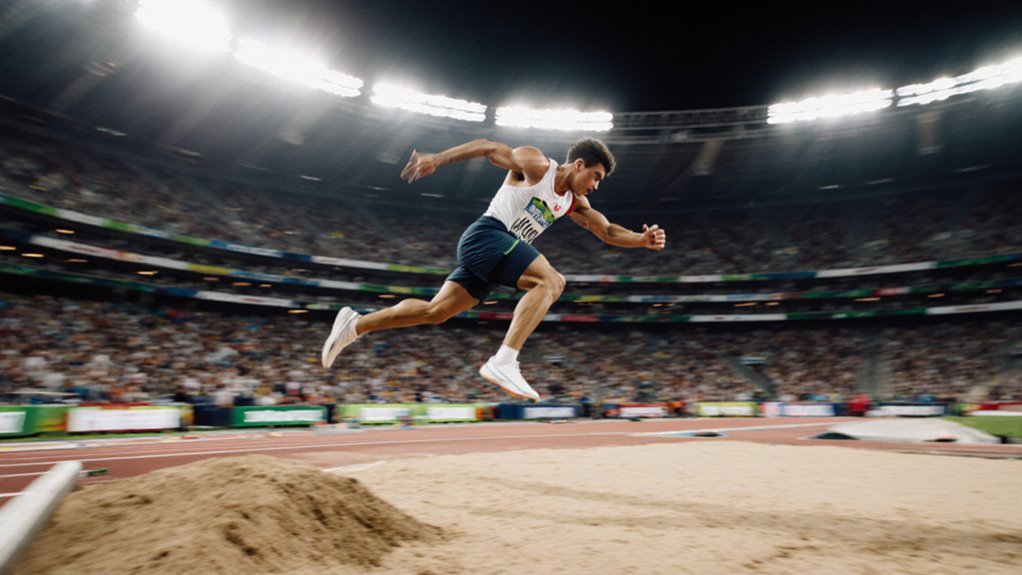

A triple jump converts runway speed into three coordinated phases: hop, step, and jump, finished with a controlled landing in the sand. The athlete sprints, takes off from the board, lands on the same foot for the hop, switches feet for the step, then launches into the final jump. Proper timing, technique, and balance maximize distance and prevent fouls. Small errors in foot placement or rhythm reduce performance and increase injury risk. This event combines sprinting power, plyometric strength, and precise technique.
What Is the Triple Jump?
The triple jump is one of track and field’s most exciting and tricky events, because it asks you to stay fast, balanced, and brave all at once.
You sprint to a board, then you make three linked moves: hop, step, and jump.
On the hop, you land on the same foot you used to take off.
On the step, you switch to the other foot.
Then you launch into the sand pit.
Every inch counts, so you need sharp athlete psychology and steady focus to avoid a foul.
Good injury prevention matters too, because strong technique helps your body handle the force.
Once you understand the rhythm, you can feel like you belong in the event, not lost in it.
How the Triple Jump Started
Because people have loved long, dramatic jumps for a very long time, the triple jump didn’t appear out of nowhere. You can trace its roots to an ancient contest in Greek accounts, where writers described multi-stage leaps and poets praised huge distances. | Era | Clue | Meaning |
| Ancient Greece | Multi-stage leaps | Early inspiration |
|---|---|---|
| Irish Tailteann | Geal-ruith | Clear cultural parallels |
| 1896 Olympics | Two-hops-and-a-jump | Modern start |
| 1908 era | Standard form | Global rules |
| 1996 | Women’s event | Wider inclusion |
Irish tradition adds another thread, and you’ll see strong cultural parallels in the geal-ruith at the Tailteann Games. Upon the modern Olympics commenced in 1896, you could finally watch the event on a world stage, and James Connolly won the inaugural title. Around about 1908, the hop-step-jump shape became standard, so you’d recognize the event today.
The Three Triple Jump Phases
Mastering the triple jump starts with grasping its three linked phases, and each one asks your body to do a different job without breaking the rhythm.
Initially comes the hop, where you take off and land on the same foot.
Then you move into the step, or bound, and land on the opposite foot.
Finally, you launch into the jump and reach the sandpit.
World Athletics counts a foul should you miss those foot changes, so phase shifts matter a lot.
With rhythm training, you learn to keep speed flowing while each phase gets a little taller.
That balance helps you stay quick, controlled, and confident.
In case you nail the sequence, you feel like you belong in the runway dance, and your jump shows it.
How the Triple Jump Approach Works
You start the triple jump approach with a controlled sprint down the runway, so you can build speed without losing control.
As you near the takeoff board, you need sharp foot placement, because even a small miss can cause a foul.
Then you settle into a steady rhythm, and that last stretch helps you launch into the hop with confidence and timing.
Runway Sprint Setup
The triple jump approach starts long before the athlete reaches the board, and that run has to feel smooth, fast, and under control. You set your rhythm in the athlete lane, then lock it in with starting drills and a fixed count of strides. Those marker cues help you hit the same pattern each time, so your penultimate and final steps line up without panic.
The runway is usually at least 40 meters long, giving you room to build speed while staying relaxed. Your goal is simple: keep high horizontal velocity and keep your bounce ready for hop, step, and jump. Coaches also adjust board position for your level, so you can attack the runway with confidence instead of fear.
Takeoff Board Precision
Stride by stride, the triple jump approach turns into a sharp trial of trust, timing, and nerve. You build speed, then lock in run up calibration so your takeoff foot lands on the board every time. That board sits as a painted line in the runway, and board psychology matters because you want to attack it, not fear it.
- Image your shoe striking the board’s edge like a drumbeat.
- Image officials watching a plasticine strip for any tiny overstep.
- Image the sand mark measuring only from your closest legal point.
When you stay precise, you protect your jump and keep your distance alive. Coaches move the board forward or back in practice so your rhythm feels familiar, and you start each attempt feeling steady, ready, and part of the group.
Rhythm Into Hop
Once your foot keeps finding the board with confidence, the run-up starts to feel like a steady drumline that carries you into the hop. You sprint down the runway with full speed, but you stay calm and tall. Your last three steps set the rhythm. The penultimate step quickens, then your final step lengthens just enough to place you on the edge of the board without a foul. Coaches use markers and start checks to help you lock in that spot. As you move, your rhythmic breathing and visual cues keep your mind settled.
This approach turns forward speed into hop power, so you can rise smoothly into the next phases. Whenever you keep the pattern steady, the hop feels bold, balanced, and completely yours.
Mastering the Hop Phase
Drive forward into the hop with purpose, because this initial phase sets the rhythm for your whole triple jump. You start on one foot, then land on that same foot with control. Consider single leg strength and arming mechanics working together, like teammates on your side.
- Push off the board edge, and let your chest stay slightly forward.
- Float like you’re crossing a narrow stream, not leaping for the moon.
- Land with a pawing action and heel-first contact, so you absorb force fast.
Keep the hop long, but not wild. Should you stay too flat or too high, you’ll bleed speed. Were you to make it too short, you give away distance. With short-approach drills and clean board placement, you build rhythm, confidence, and a place on the team.
Driving Through the Step Phase
As you leave the hop, the step asks you to stay quick and calm, because this is where your speed either keeps flowing or starts to leak away.
You land on the opposite foot, and you use the hop’s backward pawing action to keep your forward momentum alive.
Keep your torso tall, your lead leg high, and your hip forward so your body stays in line with the track.
Then snap the takeoff foot down, and push with a short, sharp ground time.
Consider triple-extension, not a long squeeze.
Your arm drive should match your coordination patterns, so every part moves together.
On the single leg, reactive drills and short hop-to-step reps help you feel fast and sure.
Watch board placement so you stay set for the pit.
Finishing Strong in the Jump Phase
Now you need that explosive final takeoff, using the speed you’ve built to push off powerfully and still stay tall in the air.
Keep your arms and free leg driving forward so you hold your flight and don’t lose precious distance.
Then focus on a controlled sand landing, with your feet together and slightly forward so you can protect your mark and finish the jump cleanly.
Explosive Final Takeoff
Explode into the final takeoff with confidence, because this is where your triple jump really gets to show off. You drive off the opposite foot, snap the leg down fast, and turn speed into lift. With plyometric conditioning and reactive strength, your body learns to answer the runway like a coiled spring.
- Imagine a quick step, then a sharp rise, like you’re bouncing off a hot track.
- Hold your chest tall and your eyes forward, so your power stays stacked and ready.
- Extend your leg hard, drive your hips through, and let the jump feel clean and bold.
Keep the step contact brief and stiff, because every extra moment on the ground steals momentum. Then carry that strong body line into the air, and you’ll feel like you belong in the circle with the best of them.
Controlled Sand Landing
In the sand, the finish matters just as much as the flight, because a clean landing can protect all the hard work you’ve already put into the jump.
You want your feet together, slightly ahead of your body, so the nearest mark stays forward and your result isn’t cut short by a hand or seat.
Keep your chest tall, drive your knees through, and land flat or just on the forefoot with your hips over your feet. That sand technique helps you stay balanced instead of tipping back.
During the initial jump, stretch your legs out in the air so your feet meet the pit initially. Then use landing drills and core work to control the drop, absorb impact, and keep your mark honest.
Triple Jump Rules and Fouls
As you watch a triple jump, it can look wild and fast, but the rules keep it fair and precise. You belong in this event when you know the basics: hop, step, then jump, with each phase landing on the right foot in order. If you take off beyond the board, even by a tiny mark, officials call a foul.
- Imagine your foot hitting the board cleanly, like a drumbeat.
- Envision the sand waiting for your landing.
- Visualize a red flag for a mistake, or white for a legal try.
You’ve also got about 90 seconds to start, so time violations can end your chance before you move. In rule interpretations, wind over +2.0 m/s still counts as wind-assisted, not record legal.
How Triple Jump Measurements Work
How do officials know a triple jump is legal and not just a huge splash into the sand? They use a careful measurement technique that starts at the take-off line, which is the front edge of the board or painted rectangle. Then they measure straight back, perpendicular to that line, to the nearest mark you leave in the pit. Provided your foot crosses the board and hits the plasticine or tape, you get no mark at all. Wind can matter too, because a tailwind over +2.0 m/s still counts for the meet, but not for records. In big meets, timing and board placement can add error sources, so judges check every detail. That way, your legal jump gets the fair distance it earned.
Triple Jump Board, Pit, and Runway Setup
You start on a long runway, so you can build speed before you reach the takeoff board.
The board’s far edge marks the legal line, and the sand pit waits just beyond it to catch your landing.
Officials also place wind gauges nearby, because even a strong tailwind can change how your jump counts.
Runway Approach
The runway approach sets up the whole triple jump, so every meter matters. You build speed with steady stride length, a calm approach tempo, and a slight body lean that helps you stay balanced.
Keep your runup consistency tight, because your last steps should feel familiar every time. Envision the runway like a lane that welcomes you in:
- A smooth stretch of track leading you forward.
- The board sitting like a small target near the pit.
- The sand waiting ahead, ready to catch your mark.
Coaches often move the board so you can match your last stride and stay legal. Officials watch your attempt, and you’ll feel their focus too.
Whenever your approach clicks, you don’t just run alone. You join the rhythm that other jumpers trust.
Takeoff Board Markings
Set your eyes on the board, because this small rectangle controls a huge part of the triple jump.
You start your hop from the takeoff line on the edge nearest the pit, so even a tiny step matters. At school meets, coaches might move the board to 12 m, 9.8 m, or 7.3 m from the pit so you can jump with confidence.
On a full runway, the board, centerline, and pit stay in one straight line, which helps you feel steady. At bigger meets, a clay strip on the far edge shows a foul should your foot cross it.
Good board calibration and careful edge wear checks keep the setup fair, friendly, and ready for your best jump.
Sand Pit Landing
Now that the board marks your takeoff, the runway carries you straight into the sand pit, where the jump finally gets measured and judged. You land in loose sand that’s deep, wide, and ready to slow you safely. Officials check the closest mark in the sand, then measure from that point to the front edge of the board. At many meets, the pit sits about 13 m away for men and around 11 m for women and club athletes, so your approach still feels natural.
- Imagine clean, level sand with crisp landing marks.
- Envision a long, spike-friendly runway that keeps your rhythm steady.
- Visualize pit maintenance that keeps the surface smooth and the sand composition soft.
Triple Jump Training Tips That Help
| Drill | Purpose | Cue |
|---|---|---|
| Bounding | Build single-leg power | Stay tall |
| Short hop-step series | Train rhythm | Keep speed |
| 30 m sprint | increase approach pace | Relax your shoulders |
| Board check run | Improve accuracy | Hit it clean |
Use 16 to 20 strides, or a shorter setup that fits you, so you reach the board without fouling. Then add power cleans, resisted sprints, Nordics, and depth landings. Mix hop-only and step-only work from 3 to 6 strides, then full run-throughs. Track jump counts and fatigue so you can train hard, stay safe, and feel like you belong on the runway.
Triple Jump World Records
You can start with Jonathan Edwards’s men’s world record of 18.29 meters, set in 1995, since it still stands as the standard everyone chases.
On the women’s side, Yulimar Rojas holds the outdoor best at 15.74 meters, and her marks show how close the event can get to perfection.
You also need to bear in mind that wind matters, because anything over +2.0 m/s won’t count for record purposes, even though the jump looks astonishing.
Men’s Record Mark
The men’s triple jump world record sits at a level that still feels almost unreal, and that’s part of what makes it so thrilling. You can feel the pull of record conditions and elite milestones every time the bar moves closer to 18 metres. Jonathan Edwards owns the outdoor mark at 18.29 m, and Kenny Harrison’s Olympic 18.09 m also stands tall.
- Envision the runway under bright stadium lights.
- Visualize a landing pit where one step can change history.
- Hear the crowd rise as an athlete breaks the 18-metre barrier.
You’ll also notice that wind-assisted jumps can fly farther, like Edwards’ 18.43 m, but officials keep them separate. Because several men, including Christian Taylor and Jordan Díaz, have joined this rare club, you can belong to a lineage of true jumpers.
Women’s Record Mark
Leap into the women’s triple jump record story, and you’ll find a mark that keeps raising the ceiling for everyone. Once you follow female milestones, you see World Athletics initially ratified women’s records in 1990, with Li Huirong’s 14.54 m as the opening benchmark.
Then Anna Biryukova broke 15 metres in 1993, and Inessa Kravets lifted the standard to 15.50 m in 1995, a mark that stood for years. Today, Yulimar Rojas leads the way. She owns 15.74 m indoors and 15.67 m outdoors, plus many jumps over 15.30 m.
That progress feels powerful because it shows you where the event can go. Still, record controversies can appear whenever wind or ratification rules come into play, so only legal marks count.
Record Conditions And Notes
Record marks in the triple jump only count provided everything around the jump holds up, so the numbers tell a stricter story than they initially seem. You’re looking at more than distance; you’re checking legal wind, doping control, and venue rules.
- Jonathan Edwards owns the men’s outdoor mark at 18.29 m, with +1.3 m/s wind in Gothenburg.
- Yulimar Rojas owns the women’s outdoor and indoor best at 15.74 m, and her Olympic record is 15.67 m.
- Altitude effects can lift a jump, but only clean marks stand as records.
When wind goes past +2.0 m/s, you get wind assistance, and the result gets listed, not ratified. You’ll also see annotations on marks like João Carlos de Oliveira’s altitude-marked 17.89 m and Lazaro Betancourt’s annulled 17.78 m.
Top Men’s and Women’s Triple Jumpers
As soon as you look at the top men and women in the triple jump, you’re really seeing the edge of human power and timing in one fast, three-part move.
In a legends comparison, Jonathan Edwards still stands out with 18.29 meters, while Christian Taylor and Pedro Pichardo show how technique evolution can keep pushing the event forward. Taylor has cleared 18.00 meters, and Pichardo keeps landing big marks near 18.08.
On the women’s side, Yulimar Rojas gives you the modern standard, with 15.74 indoors and 15.67 outdoors, while Inessa Kravets reminds you how rare greatness feels with 15.50.
Whenever you follow these athletes, you join a group that values rhythm, courage, and clean takeoff.
Triple Jump History at the Olympics
The same skill that makes today’s best triple jumpers so exciting also shaped a long Olympic story, because this event has been part of every modern Games since Athens in 1896. You can almost hear the crowd as James Connolly won the inaugural title, and the early format used two hops on the same foot before the jump. Soon, Olympic evolution settled on the hop-step-jump pattern, and by 1908 it felt fully at home.
A standing version once appeared too, but it faded away.
- Envision the runway under bright stadium lights.
- Picture feet driving hard, rhythm building.
- Feel the sand waiting at the end.
Women’s triple jump arrived in 1996, showing real gender inclusion. Since then, you’ve seen champions like Kenny Harrison and Yulimar Rojas leave marks that still inspire you.
Frequently Asked Questions
How Is Triple Jump Calculated?
You calculate it by measuring your jump from the takeoff line to the nearest sand mark, then adding no separate phase distances. Your fouled attempts count as nothing, and valid marks decide your place.